1. From Adrenaline to Oxytocin
People often assume that because I spend my days navigating the high-stakes world of blood cancers and bone marrow transplants, I must be immune to panic. They think that because I have a background in pediatrics and a career as a Hemato-oncologist, I have the human body completely figured out. The truth is, my ability to compartmentalise started long before medical school. I grew up in a home that smelled of sun drenched jasmine and old books, where my parents taught my brother, Aditya, and me that resilience wasn’t just a choice—it was a muscle we had to flex every single day. There were no traditional ‘boy’ or ‘girl’ roles in our house. We were raised on a steady diet of grit and taught to be our own heroes. That specific foundation is what pushed me into the intense, uncompromising world of clinical medicine. You learn very quickly how to stay perfectly calm while everything else is falling apart.
I remember one specific night in the emergency room early in my career. A young man was rushed in, his pulse fading fast. The room immediately erupted into a blur of shouting nurses, blaring monitors, and sheer, chaotic panic. But as I stood at the head of his bed, my hands moved entirely on muscle memory to intubate him. In that moment, I wasn’t a person with fears or anxieties; I was a highly trained technician. I calculated his drug dosages and monitored his dropping blood pressure with a cold, clear focus. I held a human life in the balance, and I didn’t let my own heart skip a single beat.
For a long time, I was fiercely proud of that clinical detachment. I viewed it as my armour. It was the shield that kept me sane while managing lethal diseases and making impossible calls. I honestly believed that because I could run a code, calculate chemotherapy down to the milligram, and survive gruelling hospital shifts, I knew absolutely everything there was to know about human endurance. And then, at 38, I stepped out of my white coat, walked into a delivery room, and became a mother. The transition felt like a head-on collision. That ER shield, which had protected me from the trauma of the wards, offered no protection against the soft, persistent cry of my son, Agastya. I quickly realised that the ‘grit’ my parents had meticulously built into me was the wrong tool for this new war. They had raised me to survive by pushing through, by outworking the pain, and by never showing a crack in the porcelain. But you cannot ‘outwork’ a newborn’s hunger, and you cannot use clinical logic to soothe a soul that feels like it’s being erased by sleep deprivation.
At 3:00 a.m., the nursery would become a world of shadows, lit only by the blue glow of my iPad or the dim hum of a nightlight. That light showed a kind of exhaustion that no medical residency could have prepared me for. In the hospital, I was a woman of science and protocols. But in those quiet hours before dawn, I was just a mother—feeling raw, overwhelmed, and terrified that I was barely staying afloat. I used to handle life-or-death emergencies without breaking a sweat. I truly believed that surviving a 48-hour hospital shift was the ultimate test of strength. I was wrong. The fatigue of a new mother isn’t something a cup of coffee can fix; it is a heavy fog that settles into your very bones.
I felt a crushing pressure to ‘have it all’—to be the clinical expert, the perfect partner, and the natural mother. But the reality was messy. My back ached, my skin was cracked, and my mind felt like a storm I didn’t know how to navigate. As a doctor, I knew the mechanics of lactation; I knew the benefi ts of colostrum and the importance of a good latch. But knowing the ‘why’ didn’t make the ‘how’ any less painful.
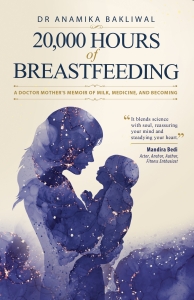
This book is my way of making sense of that struggle. It isn’t a dry medical guide; it is an honest look at the journey from the adrenaline of the hospital to the oxytocin of motherhood. I am writing this for every mother who has sat on the fl oor in the middle of the night, wondering if she is enough. In the chapters ahead, I will peel back the layers of this transformation. You will see the woman I was before the nursery—a clinician in the high volume, high-stakes trenches of hematology, operating with the tireless discipline of a soldier. I’ll take you into the reality of that life: the endless night calls, the weight of counselling patients through their darkest hours, and the grit required to maintain that pace while my own body was quietly changing. I will share the moment I fi rst discovered I was pregnant, and why, despite my clinical exterior, I have always been deeply fond of children. Being a mother wasn’t just a late-life decision; it was a role I had yearned for since I was a child myself. These pages will tell the story of how a woman trained to fight death finally learned how to truly nurture life.
About the Author

Dr Anamika Bakliwal
Joined: 15 Apr, 2026 | Location: Delhi, India
Bridging Science and Soul: Dr. Anamika Bakliwal "I am Dr. Anamika Bakliwal, an accomplished Adult & pediatric Haemato-oncologist and Bone Marrow Transplant physician with over 14 years of experience. My career has been forged at the intersection o...
Comments