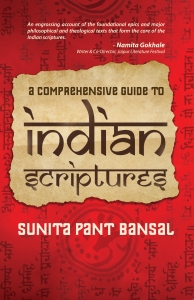
1. SHRUTI or VEDA
The Vedas are accorded the highest position in the Hindu scriptures. The Hindu religion is also referred to as Vedic religion, because all later texts, including the Bhagavad Gita accept the supremacy of the Vedas.
Veda comes from the Sanskrit root vid, meaning ‘to know’ hence the term veda signifies knowledge. The Vedas were revealed by God through sacred sounds to ancient sages, heard by them during intense meditation. These sages transmitted them to their disciples. The Vedas say that they are the breath of God—God and the Vedas are as closely connected as we are to our breath.
There is nothing in the Vedas themselves to indicate when they were composed. It is believed that they were mostly composed sometime between 1800–800 BCE. There are varied opinions regarding the antiquity of the Vedas, but all conclude that they existed even before the formation of the universe. The spiritual interpretation is that the Divine Truth always existed and was revealed to the sages in their higher states of consciousness. It is similar to the scientific view that knowledge has always existed, the scientists merely discover that knowledge, for example, gravity existed before Newton discovered it.
Understanding the Vedic truths is more important than trying to fix the date of their origin, since the latter can never be ascertained with precision. Of all the scriptures in the world, the Vedas alone are liberal in philosophy, saying that knowing or learning them is not essential. The Vedas do not insist that there is only one way of leading a good life. They say that any path followed with sincerity will lead to the same goal.
The Vedas predate idol worship. They refer to devas, meaning the bright ones, who are the manifestations of different aspects of the One, Supreme God. Vedic devas or deities include Agni, Indra, Ashvins, Maruts, Ribhus, Rudra, Vayu, Brihaspati, Vishnu, Usha, Saraswati, and Mitra-Varuna. Worship done through the prescribed rituals invokes these devas. But then, there is no idol worship, and there are no temples dedicated to Vedic devas.
The ancient sages first composed the hymns of the Rig Veda offering them to God, the Great Spirit. Rig means verse and veda means spiritual knowledge of how all things in the universe came into existence and for what purpose. This was the first Hindu scripture.
Subsequently, the brahmins or the priests made anthologies from the Rig Veda, which were put together to make the Yajur Veda, a manual for the brahmins to conduct sacrifices. Another collection from Rig Veda was made, called the Sama Veda, a collection of hymns for chanting while making offerings to God. A fourth collection called Atharva Veda was made much later. It contained common healing practices, superstitions and folklore.
Initially, the knowledge of Vedas was imparted orally to successive generations. This process continued for many centuries before they were written down. It was Sage Vyasa who compiled and classified them about 5,000 years ago and wrote them down on the banks of river Saraswati. After arranging them in their present form, he distributed them to his four disciples. The sage gave Rig Veda to Paila, Sama Veda to Jaimini, Yajur Veda to Vaishampayana, and Atharva Veda to Sumantu. These four sages taught them to their disciples, who passed them to the later generations and so on.
Science talks about the world being embraced by the concepts of time and space. The Vedas advocate that truth can be realised only by freeing oneself from the concepts of time and space. This is possible only when we turn our gaze inwards, in which we forget ourselves as in deep sleep. The common goal of the Vedas is the well-being of living creatures, the upliftment of individual Self or jeevatma and finally, the union of jeevatma with paramatma or God. In essence, the Vedas aim at liberation of Self while living in the world.
Each Veda has four sections, the first one is the Samhita containing prayers and invocations to Vedic deities. The second one is the Brahmana that explains the meaning of prayers and gives instructions for rituals. The third is Aranyaka, giving symbolic and philosophical meanings of the prayers. The last section is the Vedanta or Upanishad, doing away completely with rituals and gods, and exploring the nature Ultimate Reality and how we can reach the goal of life.
But then, the four divisions of the vast ancient Indian Vedic literature are not fixed but fluid. There is no absolute universally true distinction between Aranyakas and Brahmanas. Likewise, there is no absolute distinction between Aranyakas and Upanishads, as some Upanishads are incorporated in a few Aranyakas.
As a student, a brahmachari, one is advised to chant mantras and lead a controlled and virtuous life, following the Samhitas. As a householder or grihastha, one is expected to observe the injunctions of the Brahmanas. In the third stage of life, namely vanaprastha, which is the forest dweller’s stage, one is supposed to meditate upon the underlying spiritual truths behind the rituals, as found in Aranyakas and practise renunciation. Finally, as stated in the Upanishads, as a sannyasi, one has to seek the ultimate truth and know Brahman for liberating oneself.
Other than yoga, meditation, self-realisation and such spiritual subjects, the Vedas also talk about all the sciences as we know them today.
While the Greeks spoke of a flat earth, the Vedas had long ago declared that earth was round, and it revolved around the sun which was the centre of the solar system. And that the solar system was held together by the gravitational pull of sun and the planets. It was many centuries later that Newton discovered gravity.
Vedic literature shows that ancient Indians knew about atoms and quantum physics. The complete atomic structure is explained in the Rig Veda. All elements have the same source of energy that the Vedic sages called Chaitanya, which though invisible, can be perceived through several of its manifestations. Modern scientists agree and state that the invisible energy is seen through objects like the electrical energy is seen through lighted bulbs.
According to the Vedas, Prakriti is the building block of universe. Before the creation of universe, an amazing property of Prakriti, its dual behaviour, is described in the Rig Veda. Individually, it behaves like a particle and collectively, it behaves like energy. This period is called Pralaya Kaal, meaning a period of no-creation (or total disintegration). The only thing existing in this period is a mysterious mist, a group of particles, densely filling everywhere like an ocean of stagnant energy. No life exists as nothing is created, nor does death exist as there is nothing to die. During Pralaya Kaal, everything is inert and inactive. On arrival of the creation period, the substance of the stagnant energy becomes active and turns into the raw material for the creation of universe. Clearly, the material cause of the creation of everything is this energy, which according to the Vedas was in the form of particles. This resonates with the particle physics theories of today.
In the Vedas, Kalpa describes the cyclical process of the beginning and the end of the universe. This is in conformity with the findings of modern physics. The term light years for measuring time was known to ancient Indians as Kalpa, which is the period between the beginning and the end of the universe.
Atharva Veda has detailed descriptions of human and animal anatomy, including the skeletal, muscular, circulatory, nervous and digestive systems. It also has the science of healing, called Ayurveda, or the ancient Indian indigenous medical science.
Astronomy, astrology, mathematics, architecture, wireless communication, science of making aircraft and weapons including atomic bomb, were all part of Vedic literature.
About the Author
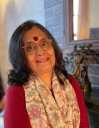
Sunita Pant Bansal
Joined: 01 Aug, 2022 | Location: Noida, India
Sunita Pant Bansal is a renowned mythologist, storyteller, and author with a career that spans over four decades. Throughout her journey, she has worn many hats, excelling as a writer, editor, publisher, and entrepreneur. She has headed publishing ...

Comments