Prologue
Dear Reader,
How often have we heard this? ‘Read the Gita, its incandescent wisdom will guide you through dark times and light your purpose!’
Through the ages, one refrain has endured, ‘Gita will carry you through life’s storms.’
Ever wondered why the Bhagavad Gita, a sacred Hindu text, has stood the test of time?
Why is it so popular across cultures and ages?
Is it because it is the shining fruit of the Indian Cultural Tree, or the crown jewel of Indian spiritual wisdom, with the Panchatantra coming a close second?
Or is it due to the recent trends where popular elected overseas leaders have taken their oath, holding the Gita while the Indian leaders have been doing so for decades? Is it a global symbolism?
Or perhaps because of those evergreen courtroom scenes in movies and serials where the lawyer grills the defendant after making them swear by the Gita to tell ‘only the truth and nothing else’?
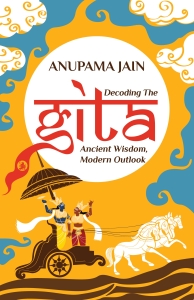
Instantly brings back visions of Lord Krishna mentoring the lost and sunken Arjuna in a chariot in the midst of a battlefield, doesn’t it?
There is just one answer.
Gita is transcendental. Period!
And Gita is ‘Sarva-Shastramayi’ or the sublime essence of all scriptures.
But … Did you know there are at least 39 Gitas in the Hindu scriptures, of which the Bhagavad Gita is the most popular?
The Ashtavakra Gita and the Avadhoota Gita are the next popular ancient compositions offering valuable teachings on renunciation and spiritual realisation. The Nisargadatta Gita, the 40th Gita, has been composed in recent times.
The Bhagavad Gita's fame stems from its profound wisdom, practical guidance, and continued relevance to human life. It offers timeless insights on duty, morality, and the path to spiritual enlightenment, making it a source of inspiration and resonating guidance for individuals across civilisations, backgrounds, beliefs and time periods.
The Bhagavad Gita is like that literary life skill podcast from antiquity that dissects human behaviour under a broad spectrum and then lays down the guidelines for a better living.
Many great ones throughout history have written about its core thesis, the takeaways, spreading Gita’s message far and wide. Many will continue to examine the Gita under varied lenses because the Gita has innumerable layers to it.
The more we seek, the deeper we dig for its hidden meanings, the more it reveals the wealth of knowledge within.
It is for the evolved, for the literate, for the commoners and for the learned.
It is meant for all to reflect upon and each to assimilate in their own way because the Gita is deeply reflective. It is for the seeker and the sceptic alike. And in that lies its universality.
This uniqueness and the depth of Bhagavad Gita where there is an epiphany for every class of reader that makes it truly an everyone’s cherished read across the world.
Also, the setting of the revelation of the absolute truth or the essence of the Ultimate by the Supreme God to a troubled soul makes it very enigmatic. Krishna’s immortal narrative about staying true to one’s Dharma, no matter what the circumstances or quandaries are, in a pitched battlefield where all the great warriors of those times had gathered to kill each other for what they believed was right, makes it pragmatic. (An understatement, definitely)
Battlefield is the metaphor for our daily life with its challenges and we hope our inner Krishna (whenever we are sagacious enough to find him) will guide our inner Arjuna through the maze of muddle of living.
Now, what makes the Bhagavad Gita so relevant?
Contemplation and questioning the status quo are universal. That is evolution.
The Bhagavad Gita addresses this probing by the human psyche in a universal language that is perennial and perpetual.
It has been a torch in the fog of moral confusion for international thinkers. Ralph Waldo Emerson felt Gita was a voice from a distant past that still resonated with contemporary concerns. Gandhi viewed it as a guide for ethical and spiritual warfare within oneself, emphasising non-violence, discipline and self-mastery. For Aldous Huxley, the Bhagavad Gita is perhaps the most systematic scriptural statement of the Perennial Philosophy.
The Bhagavad Gita or simply the Gita, is a cornerstone of the profound Hindu philosophy. Its comprehensive teachings on dharma, yoga, and spiritual liberation, gives us a framework, a template for leading a meaningful life by achieving self-actualisation. It explores fundamental human experiences like doubt, fear, and the pursuit of meaning, making it relatable to people seeking guidance and wisdom.
So the Gita is a treatise on life itself!
***
Five Major Questions before We Delve into its Teachings
What exactly does Gita mean though?
The Sanskrit word ‘Gita’ meaning a ‘song’, refers to a divine message. There are multiple such passages or Gitas within the Mahabharata, the Ramayana, and the Puranas. The Bhagavad Gita translates to ‘the Song of the God’.
Why has Gita transcended across ages?
The Bhagavad Gita is a dialogue (Samvaad) between the Pandava warrior Arjuna and Lord Krishna. It is considered a foundational text in Hinduism, because their Samvaad explores themes of Dharma, that is the righteous conduct, Karma, that is action and its consequences, Yoga, that is spiritual discipline, and the nature of the soul and the divine and their interconnectedness.
The Gita encourages individuals to cultivate positive emotions, such as compassion, joy, and peace, while also addressing negative emotions like fear, indolence, greed and anger.
Thus, this revered but practical text is very relevant to the modern times with its attendant innumerable stresses, and distractions because the secret to a fulfilled and purposeful life is aiming to be centred at all times.
Hence the Bhagavad Gita has been interpreted and analysed by major thinkers and reformists, highlighting its relevance.
Where and When was The Bhagavad Gita first spoken?
The Mahabharata Yuddh or the massive war was imminent because the Kauravas had refused all the peace overtures. Before the commencement of war, Krishna gave two options to both sides, to either choose just Him or take his vast army. Duryodhana, the eldest prince of the Kauravas, picked Krishna’s vast army, while the Pandavas chose Krishna even though He had said that He would only be a guide and not participate as a warrior. Arjuna was fortunate to have Krishna as his charioteer and Hanuman on his flag.
The battlefield or the Kurukshetra was set with restless armies in various formations. The brave and valiant Arjuna, seeing that he was about to battle with his relatives, his friends and his Gurus, slumped to his chariot, even before the war could start. The realisation that he had to vanquish his own made him very vulnerable and unwilling to shoot an arrow even. To inspire a distraught Arjuna, Krishna expounded on the nature of sacred duty and the true nature of his destiny. Krishna's teachings on the battlefield of Kurukshetra, came to be known as the Bhagavad Gita.
How did the Gita attain its structure?
The Gita with its 700 verses, is part of the Bhishma Parva of the Mahabharata, a large epic poem that recounts the Kurukshetra war between the cousins Kauravas and Pandavas.
The beginning of the Gita is a dialogue between Dhritarashtra, the blind Kuru king, and Sanjaya, his charioteer. Sanjaya, who also doubled as the king’s adviser, narrated the happenings on the battlefield because he was bestowed with the divine vision (Divya Drishti) by sage Veda Vyasa (who penned the Mahabharata).
Krishna spoke the Gita to Arjuna who was going through an existential crisis, a loss of morale because he had to slay his teachers and his cousins to win the war. Krishna, in 574 verses, taught Arjuna the necessity of detachment, and the pursuit of higher knowledge, emphasising the role of devotion and the eternal nature of the soul. Arjuna understood the importance of discharging his responsibilities with unwavering commitment regardless of their outcome, and declared the mighty war open.
The Gita ends with this shloka (Chapter 18, Verse 78)
यत्र योगेश्वर: कृष्णो यत्र पार्थो धनुर्धर: ।
तत्र श्रीर्विजयो भूतिर्ध्रुवा नीतिर्मतिर्मम
Yatra yogeśhvaraḥ kṛiṣhṇo yatra pārtho dhanur-dharaḥ
Tatra śhrīr vijayo bhūtir dhruvā nītir matir mama
‘Wherever there is Shree Krishna, the Lord of all Yog, and wherever there is Arjuna, the supreme archer, there will also certainly be unending opulence, victory, prosperity, and righteousness. Of this, I am certain.’
So the next time, dear reader, if you feel torn with the noise around, ask yourself this: What would your inner Krishna say to your inner Arjuna?
About the Author

Anupama Jain
Joined: 30 Apr, 2014 | Location: GURGAON, India
Anupama Jain (AJ) Author | Mentor | Community Builder | Multi-Award-Winning Blogger | Creative Writing Consultant Anupama Jain, known as AJ, writes for both children and adults, authoring five well-received books and contributing to 13 antholo...





Comments