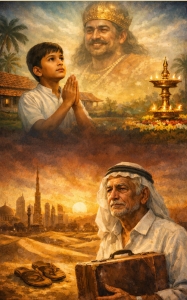
The ceiling fan in the small, third-floor flat in Ajman whirred like the old man’s breath. Outside, the December sun—less brutal than the summer, but still potent—glared off the beige tile roofs. Inside, Pappachan, who had celebrated his seventieth birthday alone last month, was settled into his favorite worn chair.
The familiar sound of the afternoon phone call broke the quiet. His grandson, Manu, was calling. Manu, twelve years old, was the only one who seemed to bridge the forty-year gap effortlessly.
Pappachan’s face, usually set in lines of exhaustion, rearranged itself into a landscape of pure joy. He quickly picked up the phone.
“Hello, Pappachen! What are you doing? Are you working today?” Manu’s voice, bright and eager, spilled through the speaker.
“Aah, ende kochu (My dear one). No work today. Just resting. What about you? Did you go to the market with Amma?”
“Yes! We bought new flowers for the pookalam . Even though Onam is two weeks away, we are preparing early. When will you come Pappachen? The temple priest was asking about you”
Pappachan’s smile faltered, replaced by the familiar ache. He knew the arithmetic of his life by heart : every flight ticket was a skipped EMI, every gift a delay in the ultimate return.
“Oh, the priest… tell him Pappachen is very busy with a big, big project for the King. It is very important. I will try next year, my darling.”
“But you always say next year, Pappachen. You have been saying ‘next year’ since I was eight! Why can’t you just take a small break? Appa says you work too hard.”
The blunt innocence of the question was a punch in the gut. He couldn't tell Manu about the 15 lakh loan, taken for Manu’s father Viju’s business venture that had failed, leaving Pappachan to shoulder the burden. He couldn’t explain that his annual leave was unpaid, and missing a month of salary meant two months of crippling interest.
He didn’t want to disappoint his only source of happiness. He thought for a moment and asked his grandson, “Manu, my little one, do you know the story of Onam? Do you know why we wait for one day every year, staring at the sky?”
“Yes! It’s the story of King Mahabali. He comes to visit us. Vamanan sent him to Patala Lokam - the netherworld.”
“You know that one, yes. But I will tell you the real story of Onam. I will tell you the story of a king who lost his land and was given only one day to return.”
Pappachan leaned back, his gaze fixed on the peeling paint of the ceiling fan—a poor substitute for the swirling green canopy of the coconut trees he remembered from his childhood.
He had been Krishnan Nair when he left Kerala in 1980, a spirited young man of twenty-five. The memories of that time were sharp and bitter. He hadn't been chasing riches when he left; he had been chasing survival. The Kerala Land Reforms Act, a monumental shift for the common man, had been a catastrophe for Pappachan's family, who owned slightly more than the ceiling allowed. But the small, ancestral plot of paddy and coconut was sliced away, leaving them with a meager, rocky holding. Suddenly, the B.Com degree that Krishnan held seemed worthless.
“They took the best five acres, the ones with the yielding coconut trees,” he remembered his father’s voice, thick with sorrow. “Go, Krishnan. Go to the Gulf. Get us all back on our feet,” his father had urged, pressing a small gold ring into his palm for the one way ticket to the Gulf.
Coming out of his reverie, he sighed, took a sip of lukewarm water from his glass and began to speak. Manu was patient and eager on the other side.
“Listen carefully, Manu. Once upon a time, there was a land of pure prosperity. Every field was green, every river was full, and every home was content. It was called the Land of Plenty. And in this land lived a ruler, a kind man who had inherited a great responsibility. Lets call him the King even though he was just a young farmer who worked hard.”
“This King loved his people and his land above all. But a new law arrived, like a massive flood, and it washed away the borders of his small kingdom. He stood on the edge of his ancestral plot, watching the best of his soil which his great-grandfather tilled slip away. The King realized that prosperity was no longer guaranteed there; his family needed a new foundation, a new source of strength.”
“So, the King decided he must seek fortune in a place far away. A place of dust and gold, ruled by a powerful Sultan. He told his beloved, ‘I will go for ten years. I will earn enough to rebuild our land, and I will come back.’”
“He traveled across the wide ocean, arriving in a land where the sun was harsh and the sand endless. This new land was his Patala Lokam. He worked as an accountant for the Sultan’s trading company. It was hard labor, full of stress, but the salary was good. He sent every rupee, every dirham, home.”
“And what did he send the money for, Pappachen?” Manu asked.
“Ah, for the promises! The King had to keep them. When his son, the Prince, needed an education in the city the King paid. When his daughter, the Princess, was to be married, the King provided the gold and the new home. Every expense, every need, was met by the King in the desert. He built a beautiful, big house for them to live in. His work, his endless toiling, became the new, shining roof over their heads.”
“But Manu, remember the old rule? When you build a palace, the cost of upkeep is eternal. The bank, like a clever deity, arrived at his doorstep. It said, ‘King, we gave you the final gold to build that palace. Now, you must pay us back, every month, for sixty more months. If you miss even one payment, the palace is forfeit.’”
The King, now older, his hair white with the desert sun, looked at the loan papers—the equivalent of Vamanan’s third step.
“I have nothing left to give you, my Lord Bank,” the King said. “My wealth is now in the hands of my children. All I have left is my own life, my own working years. Place your final step upon my head. I will remain in this Patala Lokam until every last debt is settled.”
“And so, Manu, the King was trapped. He works there still, in the Sultan’s firm, filing endless accounts. He cannot come home because his family needs the money he sends.
“So he is really stuck there because of us?” Manu whispered, the realization dawning slowly.
“Not stuck, my son. Committed. He is a King who keeps his promise. He knows that his true kingdom, the green land, is waiting for him. But he also has to fulfill his commitment to the king before he returns.”
“But Pappachen, what about Onam? Does the King get to come back on Onam?”
“Ah, yes. The one boon.”
Pappachan’s voice grew soft, almost a whisper “The King cannot always return physically. But on the day of Onam, his spirit rises from the desert. He travels back home, unseen. He walks through the doors of his home and watches his family. And when he sits at the head of the sadhya table, he laughs when you boys are happy. Even if you cant see him, he is there”
He was quiet for a moment, the weight of last forty five years pressing down on him.
After a while, Manu spoke quietly, “Pappachan….This Onam, Appa, Amma and I, we will not just pray to the God who saved the King. We will pray to you. We will pray for your safe return. We will put the tallest nilavilakku in the pookalam for you, not for Maveli. When we eat the sadhya, we will take a small portion of the payasam and keep it on the plate, a gift for our Pappachan, our King who will come home soon. You are the one who is protecting us, Pappachen. You are our Maveli.”
The words, so pure and so profoundly understanding, struck Pappachan with the force of a revelation. All the years of loneliness, the harsh sacrifices, the crushing financial anxiety, were suddenly validated, wrapped in a blanket of love.
He closed his eyes, leaning his head against the back of the chair, letting the silence of the Gulf apartment envelop him. “Thank you, my son,” he finally whispered, the two words trembling with an emotion too vast for the small room. “Thank you. I will keep those slippers ready.”
About the Author

Janhavi Ukhalkar
Joined: 13 Sep, 2025 | Location: Pune, India
Reader, Mother, Wife, Friend, Woman, Doodler - Not necessarily in that order !!...


Comments