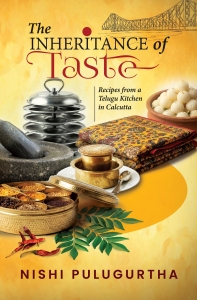
Amma’s Kitchen
Fakir Ghosh Lane, in the Dunlop area of North Calcutta, was the home that housed Amma’s first kitchen. It was on the first floor of a large building. That kitchen had, till then, been one used by bachelors. It had the basic requirements for cooking and a Laxmi Deluxe gas stove with a gas connection, not a common feature in those days. The year was 1969 and this was Amma’s first proper acquaintance with a kitchen that she would have to manage and use. This was also her first foray into a different part of the country, to a city whose language and culture were completely unfamiliar to her. She often spoke of her first encounter with the kitchen and how she had to negotiate with it. More so because she had never tried her hand at cooking before. If there was something that characterised Amma in whatever she did, it was a quiet resolve. That stood her in good stead when she found herself in the city of Calcutta that would become home to her.
Amma, my mother, Tayaru Pulugurtha (nee Duriseti), got married in October 1969. She quit her job with the then Andhra Pradesh government and moved from Hyderabad, where she had been working, and relocated to Calcutta. There is one story that she always told us sisters—before she came to Calcutta, she never cooked. She began working at the age of 17. My maternal grandfather died very young, leaving behind his wife and their six children. Amma was the eldest. She got a job at the Treasury Office in Kakinada, Andhra Pradesh, her hometown. It was initially a temporary position, but then it soon became a permanent, full-time one. She joined evening college in Kakinada and took her B.A. degree. She then went on to do her Master’s in History from Andhra University through the distance learning mode. It took her a much longer period to complete her Master’s as she was transferred to Hyderabad.
This was her first move to a new place. There, she stayed with her cousin for a while before moving into a Working Women’s Hostel. Amma loved watching films, and she often told us that it was in the new city that she got the chance to watch Hindi films. While she was working in Hyderabad, a colleague of hers brought a marriage proposal for her. He had already been in touch with her family in Kakinada.
Ammamma, my maternal grandmother, was an extremely strong and affectionate lady who cared not only for her children, but also for those of her brother-in-law. Their home in Kakinada, Amma always said, was like a sarai, an inn. There was always a steady stream of relatives from the village of Nayakampalli. They came over to the town of Kakinada to study, work, for medical care, and the like. It was always a big group of people at home, Amma always said, loads of cousins, aunts, uncles, some they had never even met before. Ammamma cared for all with great patience, never losing her nerve even once. Since Amma had to go to office, Ammamma did not allow her to cook or do any housework. Hence, the kitchen was something that Amma was not very familiar with till she arrived in Calcutta. The home that Amma and Appagaru set up in the City of Joy was a nuclear one with the rest of their family far away.
Amma got married when she was 29. I still vividly recall Ammamma, on one of her visits to Calcutta, telling me with great pride that Amma was determined not to marry till her younger sisters were married and her brothers were in college.
The gentleman she got engaged to was a cousin of her colleague at the Treasury Office. That was how the marriage proposal materialized. They were engaged for almost a year before getting married. During that one year, they wrote to each other regularly. The marriage took place in Kakinada on the 29th of October 1969, and Amma came over to Calcutta a couple of days after that.
Appagaru, my father, Hari Pulugurtha (P. Srihari Rao), had been living outside the then undivided Andhra Pradesh for some years by then. He was born in Jeypore, in the Koraput district of Western Orissa and later lived in Visakhapatnam before moving to Bhubaneshwar and then to Calcutta. Even when he was in Bhubaneshwar, he often came to Calcutta on work and liked the city. He was the Secretary to geneticist John Burdon Sanderson Haldane. After Haldane died, he toyed with the idea of relocating to Hyderabad and even Port Blair, spent some time in both places, but did not like either of them.
Calcutta it was to be for him. He had met Prashanta Chandra Mahalonobis several times before, and once he was in the city, he was offered a job by the eminent statistician to join the Eka Press at the Indian Statistical Institute, Kolkata.
When Amma arrived in Calcutta, the house in which Appagaru lived was shared by his dear friend from his school days, Sashtri Mama (Ramasastri Mangipudi), as we addressed him, and Sahu (Lakshmikanta Sahu), who had been with him in Bhubaneshwar. The kitchen that Amma encountered was a bachelors’ one. And this was her first kitchen. She had to begin from scratch. It slowly became a home for the two of them as Sashtri Mama and Sahu soon moved out. Sahu often came home to taste what she was cooking.
It was not easy for her to work her way through it. She had an ally in Appagaru, as she negotiated her life in the new city and the kitchen too. There were several things that were needed for her kitchen which were difficult to source in Calcutta. For some she had to wait for trips back to Kakinada, or wait for someone to travel to Calcutta from there to get them for her.
Her brother got her the grinding stone on one of his visits to Calcutta. He came to her home from Howrah Station, angry with the ticket collector, as he had been charged extra for the stone grinder that he had lugged along. This was a story we grew up with, one that became Pulugurtha lore. Till it arrived, there were no idlis, dosas for her. For someone who had moved to a place so different from what she had been used to, this was not an easy phase. She had to work on making other simple dishes that she began to learn slowly, over a period of time. Failing at times and perfecting her art slowly and steadily.
On her frequent trips back home to Kakinada, she began to learn more about recipes and ways and means to work her way through the kitchen in Calcutta. The inland letters from her mother had recipes too. It was this negotiation with the kitchen that led to her interest in reading recipes that appeared in English magazines that she got in Calcutta, and she started making cuttings of them. One magazine I remember her reading was Femina. She would keep these cuttings carefully in folders. Later on, Appagaru would get all of them bound into volumes. There were many such bound volumes of recipes that Amma had collected over the years. She consulted them to cook and read them at times, just for the sake of reading.
On a trip to Kakinada, Amma got Malati Chandur’s Vantalu Pindi Vantalu, a Telugu cookbook that she regularly looked up. I also remember her buying cookbooks at the Kolkata Book Fair every year.
Little by little, gradually, she went about, finding her way through the kitchen, learning new methods and modes of cooking, trying to get things that a Telugu kitchen in Calcutta would need. This last part, however, was no easy task. Appagaru knew Calcutta stores that stocked things that a South Indian kitchen would need, and these shops, located about 15 km away, would become places where they went back to often. Amma learnt her way through the city to find places where she would find ingredients for her kitchen. Amma’s kitchen went on to rustle up the most delicious tiffin that would be part of our lunch boxes. Years later, a classmate said that I always reminded her of my tiffin box. That was the time when social media began connecting us. That was also the time when Alzheimer’s Disease became a part of Amma’s life.
My sister and I became an integral part of Amma’s kitchen from a young age. She did not want us to struggle the way she had in the kitchen. So we learnt how to cook very early. All of us cooked at home. Appagaru made dinner as Amma would get home late from work. When we were able to cook, the mantle for rustling up dinner fell on the two of us. It was my sister, Usha, who was the faster learner and the better cook, too. She was the one who would experiment and create wonders. For me, it was more of a utilitarian thing at that point.
As the lockdown set in during March 2020, a number of my friends started asking me for simple recipes that form a staple of Telugu cuisine—many of them were trying their hand at cooking. The lockdown had given many people a great deal of time on their hands. I started sharing recipes with them and heard their cooking stories. That was also the time when I started penning down recipes for this book. I also did something else along with this. I started writing about our life in Calcutta—the life of a family from Andhra Pradesh (then undivided) that had made Calcutta (now Kolkata) its home. I wrote about the way in which food and culture were intertwined, and about the amalgamations and holding up that were a part of the lives of the Pulugurthas in Calcutta.
In February 2021, my mother bade us goodbye. Alzheimer’s Disease had made her a different person altogether. Her taste buds had changed completely. For someone who loved the tangy, hot things, she began to prefer sweeter dishes. Appagaru had passed away many years before her, in 2008. Their stories remain.
This volume is divided into sections. Each section has a brief description of the nature of the recipes that form part of the section. Each recipe is preceded by a personal anecdote, a memory drawn from the life of the Pulugurthas in Calcutta.
About the Author
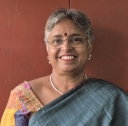
Nishi Pulugurtha
Joined: 31 Mar, 2019 | Location: Kolkata, India
Nishi Pulugurtha is academic, author, poet, editor and translator. She is Head and Associate Professor in English at Brahmananda Keshab Chandra College, Kolkata with several academic publications. Her writings include a collection of essays on travel...

Comments