
In the reign of Harun-er-Rashid, a merchant of the city of Baghdad died, leaving his vast fortune to his son Abu-l-Hasan, the Wag, who at once divided it into two equal parts: one to be set aside, and the other to be spent. Selecting several wealthy merchants’ sons as his boon companions, he lived a life of extravagance until every fraction of that which was to be spent was exhausted. At this, he called his boon companions and laid his case before them, expecting at least sympathy, if not offers of assistance. But one and all treated him with the utmost unconcern and turned their backs on him. Sad at heart, he sought comfort from his mother, complaining of the injustice of this treatment. “O Abu-l-Hasan,” said she, “it was ever thus; when you were rich, they were your friends, but now that you are poor, they look the other way.” And she wept with him, mingling her tears with his.
hen Abu-l-Hasan arose and at once took steps to withdraw the other half of his fortune from the safe-keeping in which he had placed it. Upon this, he lived as fitting his condition in life, for he was still a wealthy man. But, remembering the lesson he had learned at the cost of the other half of his riches, he took an oath that henceforth he would associate neither with relations nor friends nor acquaintances, but only with strangers; furthermore, that the extent of his association with any one person would be for one night only, the connection ceasing entirely at sunrise the next morning.
Every evening thereafter, when the purple twilight fell upon Baghdad, Abu-l-Hasan would walk through the streets of the city, saluting none, but at last stopping a stranger, upon whom he would press an invitation to good food and wine and entertainment at his house. What stranger could refuse? With the guest in the place of honour, Abu-l-Hasan drank deeply with him until morning, when the guest departed with the understanding that if they ever met again, they were not to recognise each other.
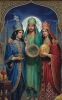
This went on night after night for a whole year, until one night an illustrious stranger accepted Abu-l-Hasan’s invitation. It was none other than Harun-er-Rashid himself, who had wandered out in disguise to amuse himself, as was his custom at times. Little aware that he was unknowingly entertaining the Khalifeh, Abu-l-Hasan led his guest into his saloon—a richly appointed apartment where every comfort was provided: streams of water murmuring through silver channels; golden fountains playing in cool grottoes; and, above all, an amber glow cast by a wondrous lamp, softening the splendour of the place into a hazy, dreamlike enchantment.
Here they reclined, and Abu-l-Hasan summoned a slave girl, slender as a willow tendril, and asked her to sing to the music of her lute. She sang sweetly then, her verses shaped by the gentle languor of the night:—
Oh, Love, your footsteps wander in distant lands,
Yet here within my heart you remain.
Even if you dwelt in some far-off star,
No breadth of space could ever part our souls.
You are my Love; through all eternity,
You are my soul, and all my world is you.
Er-Rashid marvelled greatly at the singer and her song, and wondered in his heart what kind of man Abu-l-Hasan must be, that he could entertain on so magnificent a scale.
“Tell me, young man,” he said, “what is your name, so that on a future occasion I may return your hospitality?”
And Abu-l-Hasan told him, but added with a smile, “Alas, this night must end our acquaintance, for I have so vowed it.” Then he set forth the nature and the cause of his vow, at which Er-Rashid laughed heartily and said, “By Allah, brother, I do not blame you!”
After this, the slave girls came and spread a banquet before them, and they partook of it, Abu-l-Hasan giving the choicest portions to the Khalifeh. When they had finished their meal, Abu-l-Hasan brought out his oldest and most fragrant wines, laid the wine-cloth himself, and, having lit several small lamps and candles, filled a goblet and raised it to the Khalifeh.
“Best of boon companions,” he said, “away with ceremony! Regard me as your faithful servant, and may I never be made to grieve at your loss.”
With this, he drained the goblet, and, still acting the part of the Khalifeh’s attendant, filled another for his guest and handed it to him. This pleased the Khalifeh greatly; he appreciated such delicate attention. He took the goblet and drank, saying to himself, “By Allah! I will make him a good return for this.”
Abu-l-Hasan continued to wait upon his guest humbly, and the Khalifeh enjoyed his hospitality to the full. Had his host known him to be Er-Rashid himself—which he did not—he could not have entertained him better.
At the hour of midnight, the Khalifeh spoke to his host in serious tones. “O Abu-l-Hasan,” said he, “tell me what it is you most desire.”
“Why, my master,” replied Abu-l-Hasan, “if you wish to know, my most constant prayer is that I may be freed from the constant annoyance inflicted upon me by the Imam and the four Sheikhs of the neighbouring mosque. When they hear the sound of music and revelry at night, they report me, so that I am harassed by heavy fines. By Allah! if it were in my power, I would give each of them a thousand lashes.”
“May Allah grant your prayer!” said Er-Rashid, and, unobserved, he dropped a lozenge into his host’s wine and handed him the goblet, bidding him drink.
Abu-l-Hasan did so and soon fell fast asleep. The Khalifeh at once summoned his servants, who, having followed him at a short distance, were waiting outside.
He commanded them to place Abu-l-Hasan on a mule and carry him to the Palace. This was soon done.
Later, when the Khalifeh had rested somewhat, he summoned the chief officials of his court and, pointing to the sleeping figure of Abu-l-Hasan, said to them, “In the morning, you will find this young man upon the royal couch. When he awakens, see to it that you obey his slightest wish as you would my own; salute him as the Khalifeh and bow before him.” To his women slaves, he gave similar instructions and ordered them to address Abu-l-Hasan as the Prince of the Faithful. Then Er-Rashid withdrew to another part of the palace and slept.
In the morning, when Abu-l-Hasan awoke upon the royal couch, he stared in amazement at the attendants bowing before him. “O Prince of the Faithful, it is the hour of morning prayer,” said a beautiful slave girl, stepping forward. Abu-l-Hasan laughed, for he did not know what to make of it. Then he rubbed his eyes and gazed around at the sumptuous splendour of the apartment: its magnificent roof and walls, its rich silk hangings, its vessels of gold and sparkling crystal, its jewelled furniture and ornaments, and its luxurious carpets. “By Allah!” he gasped. “Have I reached the fragrant Paradise, or is it a dream?”
With that, he closed his eyes as if to hold the dream by sinking back into sleep, but a eunuch stepped forward and kissed the ground before the royal couch.
“O Prince of the Faithful!” he said humbly. “Recall your custom.”
At this, Abu-l-Hasan, utterly perplexed, opened his eyes again very slowly and saw the rich trappings of the couch on which he lay. Little by little, he opened them until at last they were wide with wonder; for this was no dream. The voice of the eunuch who had spoken, the faces and figures of the attendants, the royal splendour of the place—all were as real as he could wish; and yet—yet—he raised his hand to his mouth and bit one of his fingers hard, then cried out with sudden pain.
Angrily, he lifted himself on one elbow and addressed one of the female slaves. “Come here,” he said.
“My lord, I am always at your service,” she answered, drawing near. “What is your will, O Prince of the Faithful?”
“Tell me,” he said, “who am I, and where am I?”
“You are the Prince of the Faithful,” she replied. “You are in your palace and upon your royal couch.”
“No, no,” said he. “I sleep. I think I dream, or—” he went on, half to himself—“Can it be? My guest—he bade me drink, and—what subtle enchantment is this? Am I now Abu-l-Hasan dreaming that I am the Khalifeh, or was I, last night and for many nights before, the Khalifeh dreaming that he was Abu-l-Hasan?”
And the Khalifeh himself, watching him all the while from a sheltered nook, delighted in the perplexity of his guest.
About the Author

Readomania
Joined: 06 Feb, 2015 | Location: , India
Take a break, read something nice, write something beautiful...




Comments