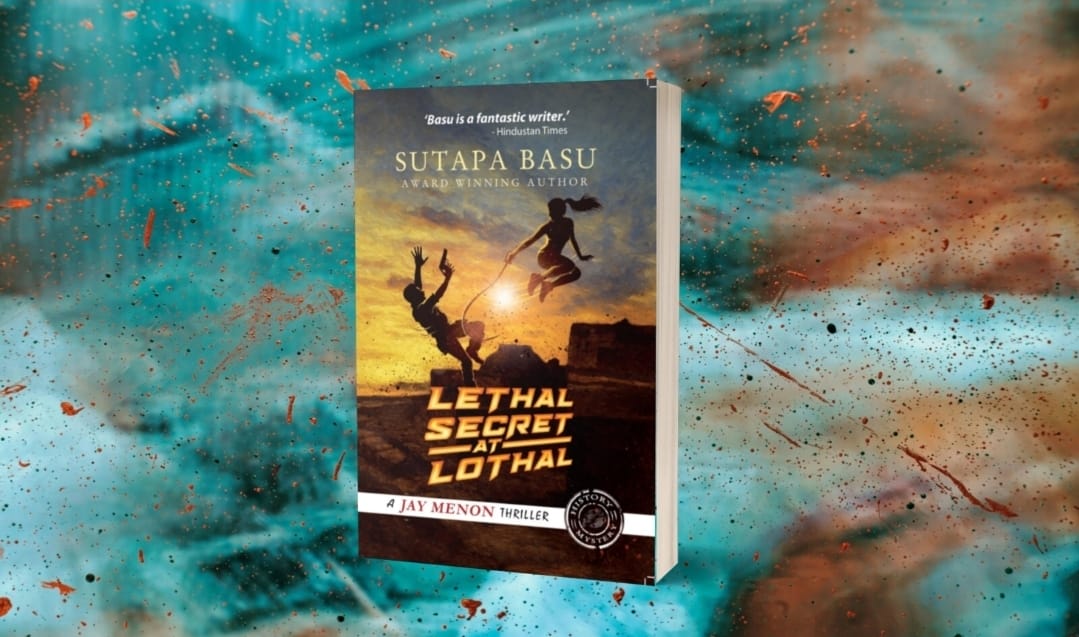
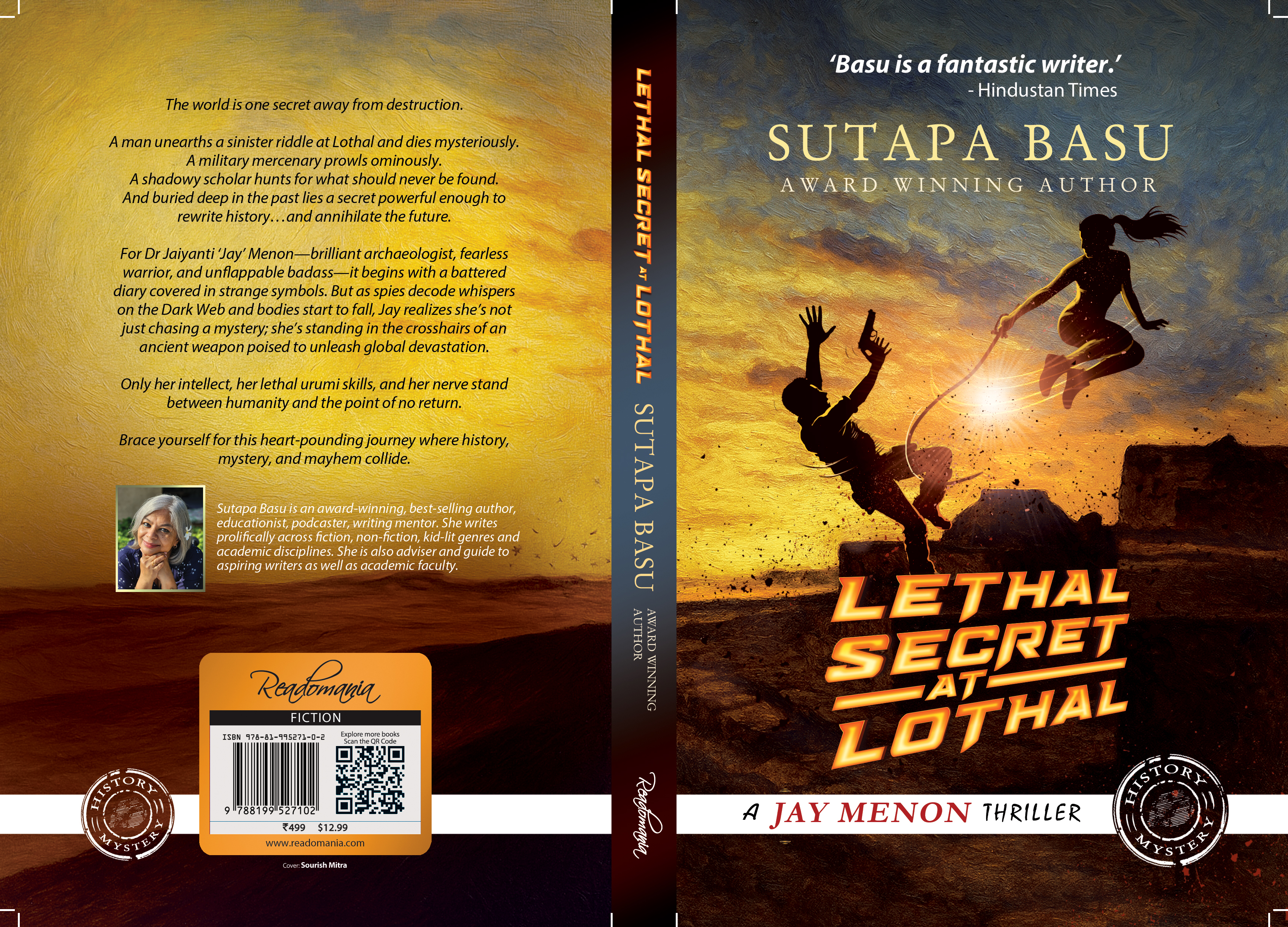
LETHAL SECRET AT LOTHAL
Relevance goes beyond mere frisson
Editor’s Take
As the editor of Lethal Secret at Lothal, I can say with complete honesty that working with Sutapa Basu is never a routine experience; it is always an education. Every manuscript of hers reminds me how astonishingly versatile she is. Whether she is writing historical fiction, social drama, mystery, children’s fiction and non-fiction, poetry or now a high-octane action thriller, she slips into the grammar of each genre with effortless confidence. She is one of the most prolific writers I have worked with, yet there is nothing hurried or careless in her craft. Each book arrives with the precision of someone who truly understands her readers.
What amazes me most is how Ms Basu dares to stretch herself every time. In Lethal Secret at Lothal, she ventures into a fast-paced, action-driven universe without losing the intellectual depth that defines her writing. The result is a narrative that feels cinematic, urgent, and contemporary, while still rooted in history. Watching her weave archaeology, geopolitics, cybercrime, and ancient mystery into a single gripping storyline was both exhilarating and humbling as an editor.
I strongly believe this book will entrap the younger generation with its relentless momentum, sharp language, and fearless, young protagonist. At the same time, its premise…the illicit trafficking of antiquities, the vulnerability of our cultural heritage, and the enduring power of the past…will resonate deeply with mature readers. This is where Sutapa Basu’s strength truly shines: she makes history feel alive, relevant, and thrilling, never dusty or distant.
Her treatment of Lothal is especially powerful. By placing this lesser-known yet extraordinary Indus Valley site at the heart of a global conspiracy, she transforms archaeology into something urgent and exciting. It feels almost prophetic that the Government of India, in the recent Union Budget, announced a scheme to develop Lothal as a major international tourist and heritage destination. The novel, in its own way, echoes that national vision, reminding us that our past is not a relic, but a living force that still shapes our present and future.
For me, editing Sutapa Basu’s work is always a learning experience. She challenges my assumptions, pushes the boundaries of genre, and redefines what popular historical fiction can achieve. Lethal Secret at Lothal is not just another thriller; it is a bold invitation to rediscover our history through the pulse of a modern adventure.
~~ Indrani Ganguly
Author’s Take
I have been an action-thriller buff for as long as I can remember. From Ian Fleming’s James Bond escapades to Alistair MacLean’s taut adventures, from James Hadley Chase’s breathless narratives to George Lucas’s swashbuckling Indiana Jones mysteries…each was an adrenaline surge. Long after I had turned the last page, the frisson lingered. I would replay the story in my mind as though it were unfolding on a cinema screen, casting myself in the lead…sleuthing in shadowy corridors, trading blows with villains, unearthing hidden treasures.
And when at last the exhilaration subsided, a quieter question would rise to the surface: why had none of my beloved storytellers envisioned a woman as the iconic protagonist of such high-voltage adventures?
One might dismiss this as the chauvinism of another era. Yet even many contemporary thrillers continue to reserve the central arena for men. True, there are notable exceptions, but a glance at some of the most popular titles is telling. The Maze Runner by James Dashner and the dystopian novel They Both Die at the End by Adam Silvera place young men at the heart of their narratives. Suzanne Collins’s The Hunger Games trilogy burst forth with the indomitable Katniss Everdeen, yet in her later works Collins, too, chose male protagonists to steer the story.
My question about this quiet but persistent gender preference simmered for years, until it demanded an answer when I began to conceive Lethal Secret at Lothal, my own action thriller. From the outset, I knew my central character would be a woman. That conviction was clear; the execution was anything but simple. How would she stride into a realm long dominated by legendary male heroes and claim her space without becoming a mere inversion of them? She would be youthful and athletic, certainly…but what of the qualities beneath the surface? What would shape her courage, her vulnerability, her moral compass? How could she be formidable and yet unmistakably, unapologetically herself?
More cerebral than brawn was the first decisive tick.
Combative yet analytical. Unconventional. Erudite but street-savvy. Sharp…occasionally sassy.
And then, in a flash of recognition, I realised that this composite bore an uncanny resemblance to my nineteen-year-old grandson. The clarity of that moment was electric. My protagonist would channel his ilk…their quicksilver intelligence, their impatience with artifice, their irreverent confidence. And they would be my target audience as well.
As the plot evolved, I found myself thinking as much about the how and why of engagement as about the what of suspense and action. Language became crucial. To operate, communicate, and emote within the Gen Z universe demanded immersion. It was both daunting and invigorating. I compiled a formidable lexicon of words that do not always mean what they appear to mean. Perhaps it is, as they say, ‘brain rot.’ I will not flex…but I daresay I managed to slay it.
History, my steadfast old companion, inevitably slipped into this literary adventure. This time she led me to Meluhha…the evocative name believed to refer to the Indus Valley Civilization. Harappa and Mohenjo-daro have long dominated both fiction and scholarship, but other Indus sites remain relatively neglected. Lothal has always fascinated me: the excavation of what is considered the world’s earliest known artificial dock, the remnants of a thriving port, the tangible evidence of maritime trade that once connected this ancient settlement to distant shores.
Information about Lothal today is but a click away. I wanted, therefore, to approach it from a different vantage point. The archaeological record testifies to the astonishing ingenuity and knowledge of the civilization’s inhabitants. In this novel, I juxtapose that testimony against the troubling realities of contemporary geopolitical crime.
Criminal syndicates operate across borders with alarming impunity. Beyond fomenting strife, they plunder cultural heritage…looting, trafficking, and auctioning antiquities to the highest bidders in the international grey market. The brazen display of Indian artefacts abroad, often accompanied by dubious provenance, has long troubled me. Despite media exposés on such illicit trade, I remain uncertain about the efficacy of countermeasures. Through this ‘history-mystery,’ I wished to do my part in exposing this malpractice…particularly to young readers. Fiction, I felt, could become a compelling vehicle for awareness.
Lethal Secret at Lothal aspires not only to be a fast-paced, engaging thriller but also to illuminate the extraordinary civilizational achievements of ancient Meluhha and to honour the painstaking work of Indian archaeologists who document and safeguard our heritage. While the narrative bears a fictional spin, the menace of global syndicates trafficking in stolen antiquities is very real…and it demands vigilant, collective action.
Action that I hope will find its fiercest champions among the heritage knights of tomorrow…today’s young readers, whose consciences are awake, and whose sense of justice is still unjaded. If this story kindles in them even a spark of pride in our ancient past, or a flicker of resolve to protect what time has entrusted to us, my tale will have achieved far more than the thrills it promises.
For beneath the chases and shadows cast by greed and conspiracy, lies a deeper conviction of my own: that our history is not a relic to be entombed, but a living inheritance. The dockyards of Lothal, the silent seals of Meluhha, the patient hands that unearth and preserve them… are all threads in a tapestry that belongs to us collectively.
If Lethal Secret at Lothal urges even one reader to look at a shard of pottery, a weathered brick, or an archaeological dig with renewed wonder and responsibility, then the journey through its pages will have been worth every peril it portrays.
~~ Sutapa Basu

Comments