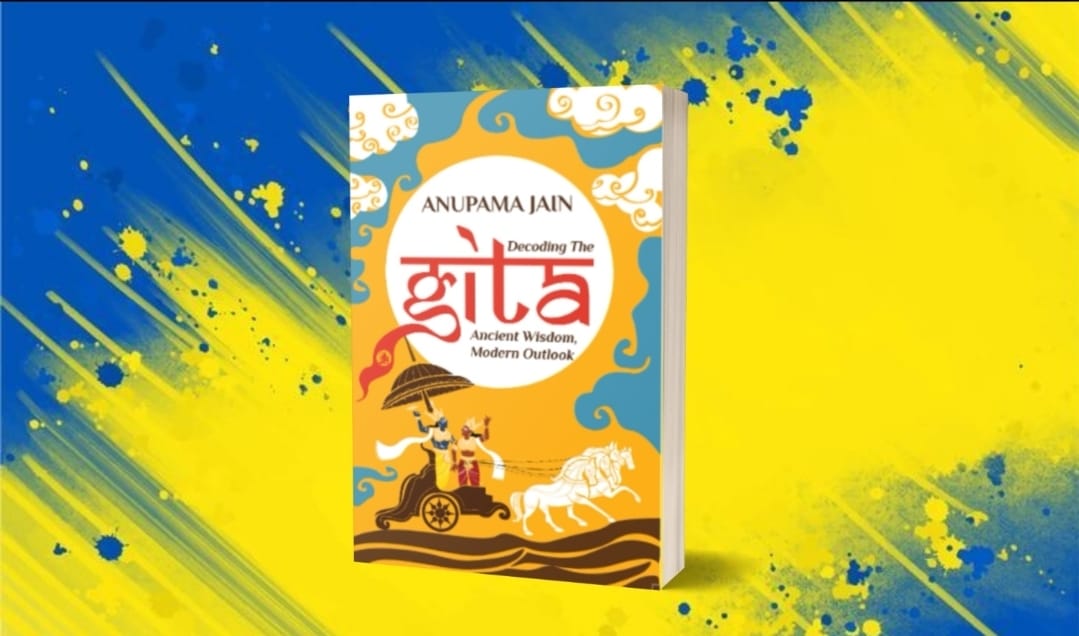
Decoding the Gita: Seven Hundred Verses and One Leap of Faith
It all started with an entirely innocuous and unexpected call from my publisher, Dipankar Mukherjee, last February, asking if I was interested in writing about the Gita. With my typical bravado, I said ‘yes’, perhaps to keep sane and navigate a particularly difficult year. After the initial euphoria had died down, the enormity of the task I wanted to undertake began to slowly sink in. I soon realised I was attempting to pour out the entire Pacific Ocean into a small mug. And there were lakhs of interpretations already in the market, with frightening eyeballs garnered.
Where was I to position my Gita? Wouldn’t it be lost in the crowd?
Was I to dumb it down or make it erudite and esoteric?
Both weren’t really my cup of tea. So I settled for the middle ground, making my interpretation as an accessible read while retaining the Gita’s profundity. Plus I had the differentiator, my core competency of decade-old mentoring across various educational boards, that gave me access to some great literary works.
My template was this. I was going to incorporate instances of world literature after every chapter, be it Shakespeare’s Hamlet, Dark Night of the Soul by St John, the tale of Sisyphus and poems by Walt Whitman and Rudyard Kipling. I would also generate implementable life hacks for today’s breathless world, which craved (perhaps unknowingly) some calm in its chaos. Which meant I had a large age group as my reader base. From 16 to 60, there was something age-appropriate to take away.
The initial months were spent in reading multiple interpretations, from the very deep to the highly playful. I read all the 700 shlokas and their explanations multiple times before I typed in the first word. I had to prepare sufficiently enough before taking the philosophical plunge.
The work on the manuscript began in earnest towards the end of May, when it was the summer break. I would often work 7-8 hours at a stretch poring over the entire text, choosing the appropriate shlokas to interpret while being mindful of the implied subtext. (Most often my limbs were quite jammed up. I had to take shots and pills for the same).

One of the most difficult chapters to write was the ‘Vishwaroopa Darshana Yoga’, Chapter 11, for its sheer grandeur and depth of spirituality. I must confess here, I have a small silver idol of Krishna, my grandmother’s. Whenever I struggled to explain correctly, unable to arrive at the right word that made sense, I would pace around, clutching this idol, often coaxing the apt expressions to grace the pages. After much duress, the cosmos would indulge me. Once the writing got done, I started with my illustrations, which were in line with the majestic ethos of Gita.
The wise have said the universe favours the souls to pen their versions of Gita and not the other way around. I have been the fortunate writer to do so, and that too in such a short span of a writing career.
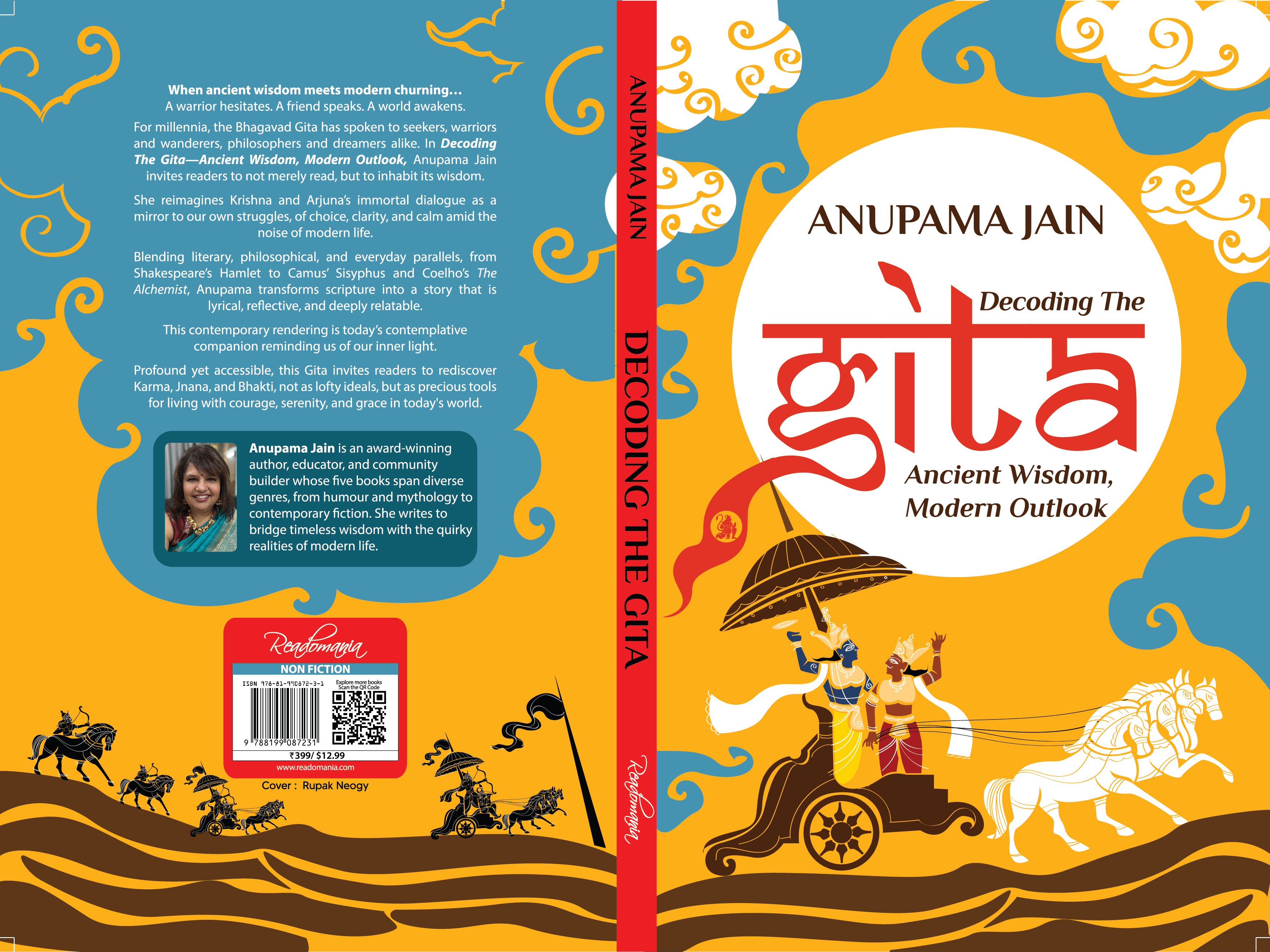
The USP of my version is its structure. Each chapter has modern literary parallels, key takeaways and actionable daily techniques. Ancient wisdom in conversation with global writings which distil into practical reflection! The format was such because the writer mode was complemented by my mentor mode.
From Padma Bani Paula to Decoding The Gita, it has been a 360-degree pivot. And I believe it has been a transformative one.
I also hold that in these days of hyper-connectivity, where online addiction is approaching pandemic levels across age groups, this book is timely. It can be someone’s anchor, where they return to this work periodically to find answers to their vexing questions, because it isn’t pedantic but approachable and hence can be easily assimilated and adopted.
Penning this book has been my privilege. I cannot wait to share it with the world, hoping our inner Arjuna finds their guiding Krishna here.
Iti Tat Sat!
Grab your copy of Decoding the Gita here

Comments