
A Mountain of Secrets, A Story of Lost Names
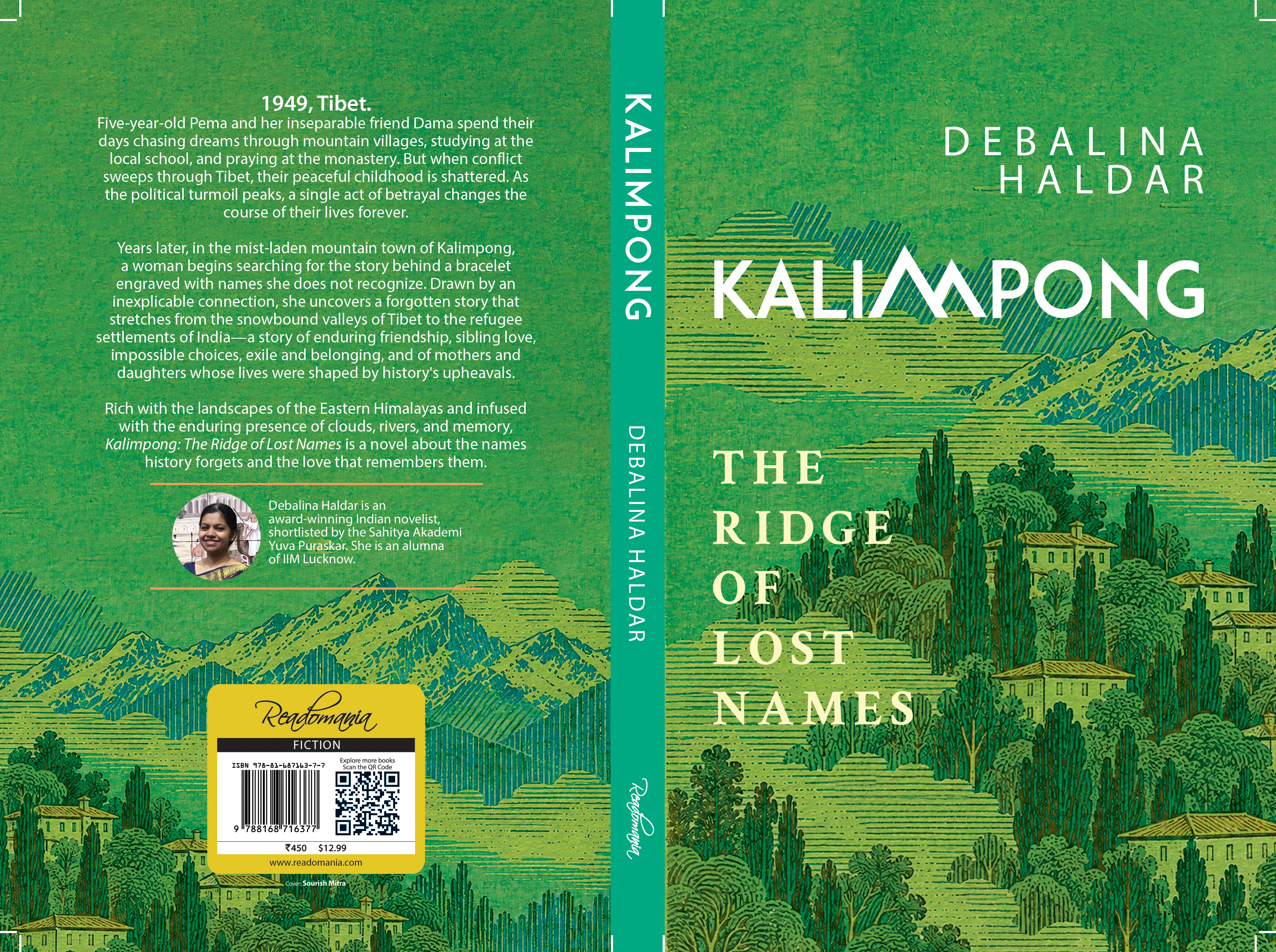
Announcing Kalimpong: The Ridge of Lost Names by Debalina Haldar
Some places are more than places.
They hold memories. They keep secrets. They remember the people who passed through them, the ones who stayed, and even those who disappeared without leaving behind anything but a name.
In the mist-covered hills of Kalimpong, where clouds drift across mountain ridges and prayer flags flutter in the cold air, there are stories that refuse to be forgotten.
Readomania is delighted to announce the publication of Kalimpong: The Ridge of Lost Names by Debalina Haldar—an atmospheric and deeply moving work of fiction about identity, belonging, displacement, family and the enduring power of memory.
At the heart of the novel is Oli, a young woman who arrives in Kalimpong soon after her marriage to Abhinandan. For Abhinandan, Kalimpong is familiar territory. For Oli, it is something far more complicated.
She was adopted at birth in Kalimpong by parents who were tourists passing through the town around 1960. She has grown up with a carefully repeated version of her origins, but there have always been gaps in the story. And there is one thing she cannot quite explain: a bracelet she has carried since childhood, bearing two names.
Then she comes to Kalimpong.
The name of the town itself has always carried an inexplicable pull for Oli. Now, living at Mon Ri, an old house perched on a ridge, she begins to encounter fragments of a past she never knew she possessed—a name, a photograph, a sealed envelope, an old story, a set of memories that seem to belong to someone else and yet somehow belong to her.
The search for answers takes Oli into the layered history of Kalimpong, where personal histories intersect with larger stories of migration, exile and loss.
And at the centre of one of those stories are Pema and Timo.
Separated from each other as children, the siblings carry the scars of displacement and the ache of a family torn apart. Their story unfolds against the experience of Tibetan exile—a history shaped by journeys across borders, uncertain identities, refugee camps, missing people and the struggle to hold on to a culture when almost everything familiar has been taken away.
Here, even a name can become fragile.
A person can disappear into a file.
A missing child can eventually become a deceased one in the records.
A refugee can be reduced to a category on a government form.
And yet, beyond the paperwork, the memories remain.
This tension between the official record and the human story is one of the novel's most powerful threads. Kalimpong: The Ridge of Lost Names asks what happens when bureaucracy decides how a life should be recorded—and what happens when memory refuses to accept that version of the truth.
But this is not simply a story about loss.
It is also a story about the ways in which people survive loss.
About women who carry families through impossible circumstances. About mothers and daughters, sisters and brothers. About people who make homes in unfamiliar places. About the quiet courage of those who continue to love, pray, work and remember when the world around them has changed beyond recognition.
For Pema, survival takes the form of flowers, prayers and an extraordinary determination to keep moving forward.
For Timo, it takes another form.
His journey eventually leads him towards the monastery, where he becomes a monk and discovers a responsibility larger than his own story. He understands that the loss of a homeland is not only the loss of land. It can mean the loss of temples, monasteries, traditions, stories, language and collective memory.
To preserve culture, therefore, becomes an act of resistance.
An act of love.
An act of remembering.
And perhaps that is why the bracelet that carries two names becomes so significant.
A small object. A simple string of beads. Two names etched into it.
Yet those names become an anchor across years of separation. They become a promise that someone has not been forgotten. They carry the possibility of reunion across distance and time.
In Kalimpong: The Ridge of Lost Names, Debalina Haldar creates a world in which objects, landscapes and memories carry meaning. A house can hold secrets. A photograph can reopen the past. A bell can carry the memory of a lost home. A name can become a lifeline.
And the mountains themselves seem to remember.
The novel's recurring presence of the Cloud adds another dimension to the narrative. Moving above the ridges, witnessing lives and carrying stories across time, the Cloud becomes an almost mythical keeper of memory. It sees what people cannot. It connects the past with the present and gives the landscape a voice of its own.
This makes Kalimpong more than a setting.
It becomes a character.
The mist, rain, fog and dew mirror the emotional journey of the people who inhabit these pages. The mountains conceal and reveal. Paths disappear and reappear. The weather shifts. The landscape seems to breathe alongside the characters.
And gradually, the movement of the novel is from mist to rain, fog to dew—from uncertainty and loss towards recognition, healing and hope.
At its heart, Kalimpong: The Ridge of Lost Names is a story about a question that is both deeply personal and universal:
Who are we when the stories of our beginnings have been lost?
Is belonging something inherited—or something we create?
Can a family remain a family across years of separation?
What does it mean to remember a place we can no longer call home?
And can the act of remembering itself become a way of finding our way back?
Debalina Haldar brings together mystery, family drama, historical memory, exile, Buddhist spirituality and an evocative sense of place to create a novel that is both intimate and expansive.
It is a story of lost children and remembered names, of women who endure, of siblings separated by circumstances beyond their control, and of people who refuse to let history erase what mattered to them.
Most of all, it is a story about the things we carry when everything else is taken away.
A name.
A memory.
A prayer.
A bracelet.
A story.
A mountain.
And sometimes, a cloud that remembers.
Readomania is proud to present Kalimpong: The Ridge of Lost Names by Debalina Haldar.
Come, enter the mist.
There are stories waiting on the ridge.
And some names are waiting to be remembered.
Click here to preorder Kalimpong
About the Author

Debalina Haldar is an alumna of IIM Lucknow, class of 2015. She started writing when she was seven years old. She writes in the literary fiction genre. Her novel, The Female Ward, was published in October 2012, by Thames River Press (UK). Her second book, Wrinkles in Memory, is a collection of 22 short stories. It was published in August 2016 by Lifi Publications. Wrinkles in Memory was shortlisted for the Sahitya Akademi Yuva Puraskar for books in English in 2020. Her novel, The Daughters of Shantiniketan, was published in August 2025 by Readomania Publishing. She is based in Bengaluru where she lives with her husband and her two children.
Instagram: @Debbie.writes

Comments