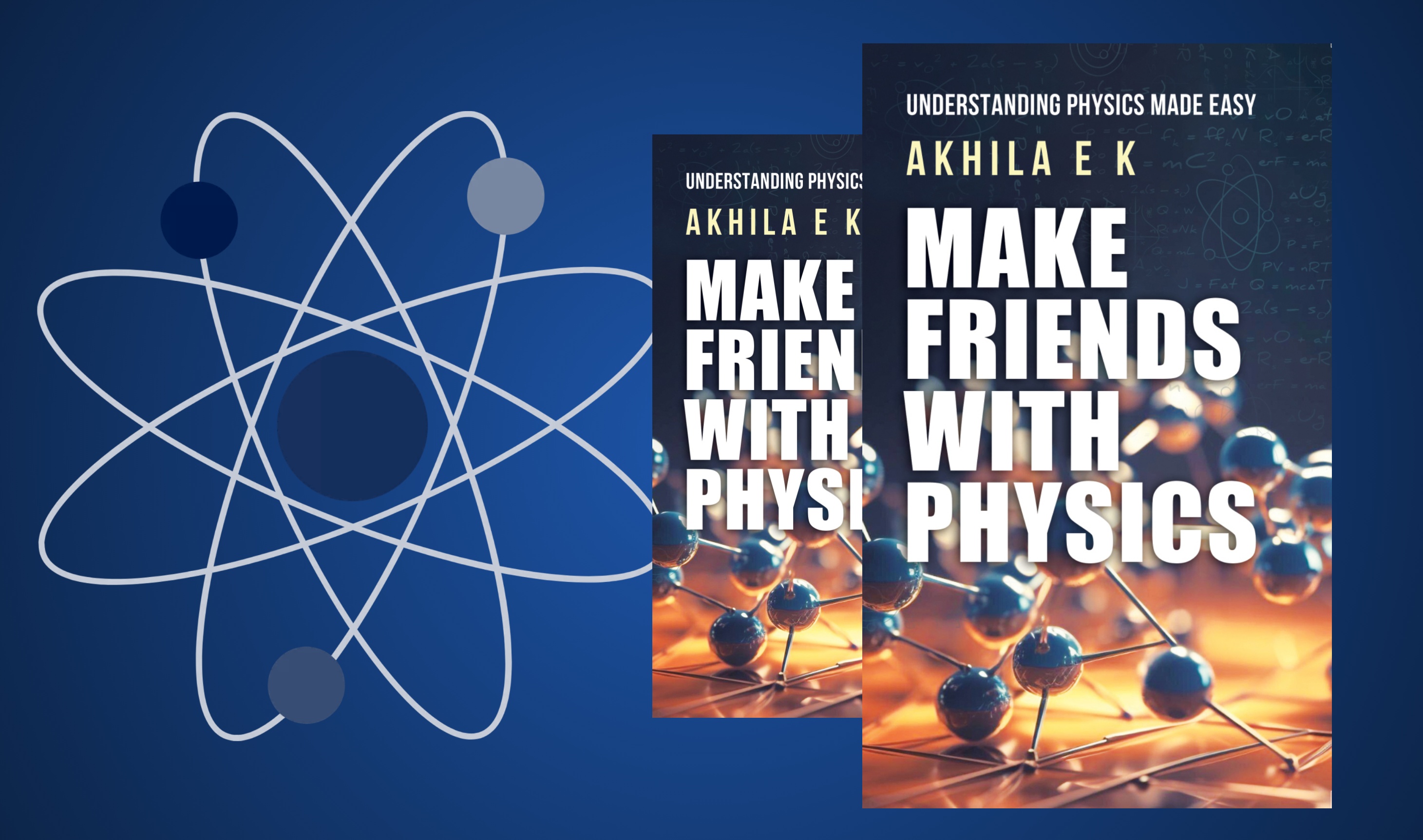
Dear Akhila, congratulations on the release of Make Friends With Physics.
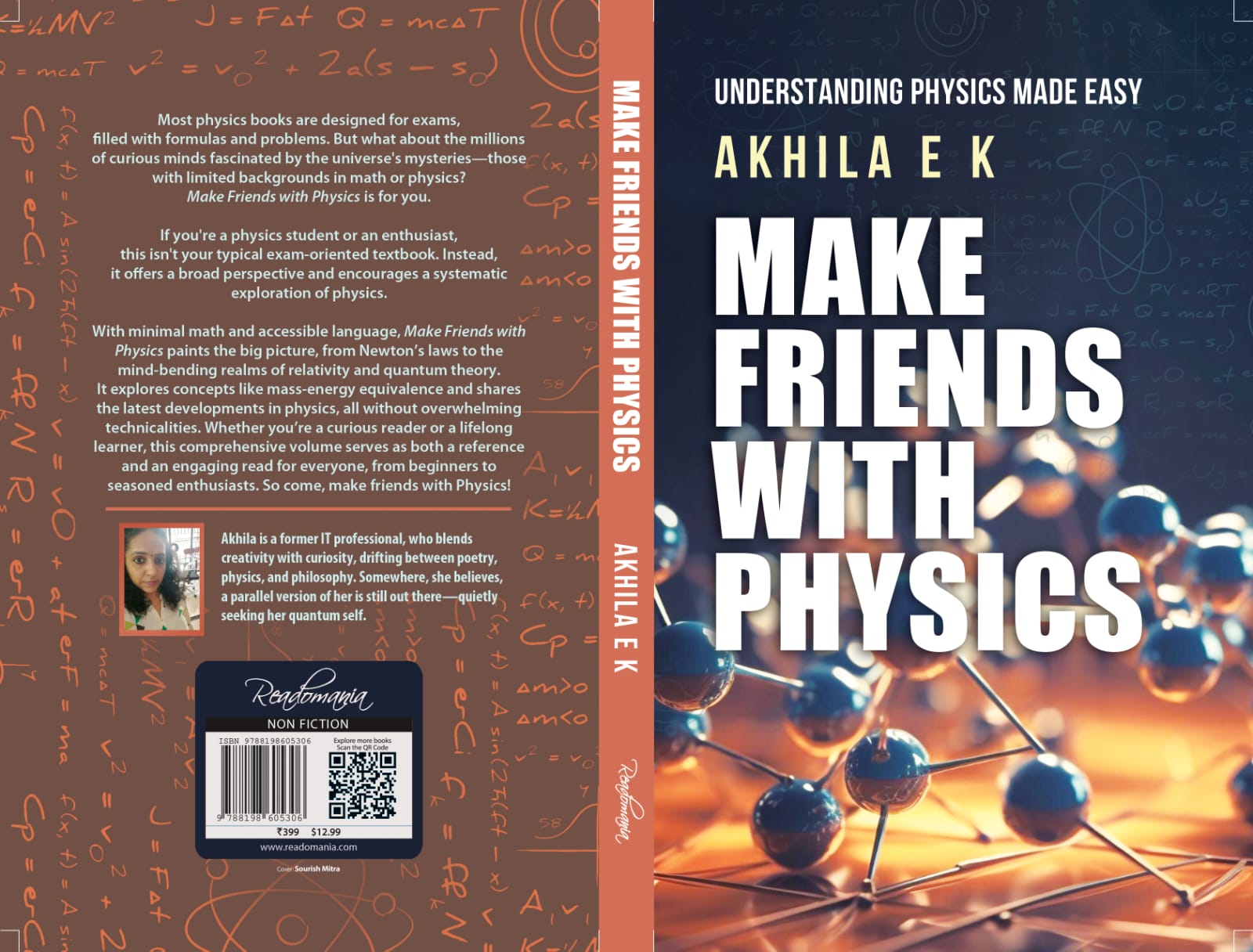
Readomania: What inspired you to write a physics book for everyone, not just students or scientists?
Akhila: I wanted to break the myth that physics is intimidating or reserved for experts. Too often, it’s taught as fragmented lessons aimed at exams, losing sight of the bigger picture of why physics matters. In reality, physics is the story of the universe — it quietly shapes everything around us, from the tiniest particles to the vastness of space.
Many curious minds love cosmic wonders but shy away from heavy math or technical language. I wanted to create a book that welcomes everyone in— showing physics in a simple, human way. I also noticed gaps in traditional learning — the overemphasis on classical tales, the underplayed modern physics, and the way concepts are often misinterpreted.
Make Friends with Physics aims to bridge that gap. It’s not about giving all the answers, but about sparking curiosity, encouraging exploration, and turning physics from a rigid subject into a lifelong friend.
Readomania: How do you balance scientific accuracy with readability when writing for a broad audience?
Akhila: I tried to focus on the ideas, not intimidating mathematics. I emphasize the story behind the equations — the “why” instead of the math. For instance, electrons aren’t points moving in fixed paths but exist as probability clouds. Visualizations and everyday analogies help make these ideas intuitive.
Readomania: What misconceptions about matter and energy do you see most often, especially among younger people?
Akhila: The most common misconception is that matter and energy are completely separate things. Many imagine energy only as electricity, heat, or light, and matter as the “solid stuff” around us. But Einstein showed us they’re deeply connected — mass itself is a form of energy, what we call ‘’rest energy’’ (well, mass is a property of matter). Mass and energy are two sides of the same coin. For example, a tiny amount of matter contains enormous energy — this is what powers the sun and, indirectly, life on Earth. I wanted a playful yet accurate way to capture that idea, so I described mass as “the energy couch potato” — energy at rest, waiting to be released under the right conditions. It makes a heavy concept lighter, sparks curiosity, and gets readers thinking about what’s really “inside” matter.
Readomania: The book bridges classical physics and modern theories. Why did you feel it was important to show this transition to readers?
Akhila: Classical physics lays the foundation for everything we understand, but modern theories like quantum mechanics and relativity show how the universe truly works. I wanted readers to see the full journey so that they appreciate how one discovery leads to the next, rather than learning ideas in isolation.
Readomania: Your book touches on dark matter, antimatter, gravity, even the Theory of Everything. Why include such big or unresolved ideas in a book for general readers?
Akhila: Because they show that physics is not complete — it’s alive, evolving, and still full of mystery. Dark matter and antimatter remind us how much of the universe is still unknown. Gravity is still the missing puzzle piece in the Standard Model, pointing to one of science’s greatest challenges: unifying all forces.
And when it comes to the Theory of Everything, I don’t claim to give answers; instead, I highlight the open questions, the ongoing experiments, and the thrill of exploration. My aim is to spark curiosity and show readers that you don’t need to “know it all” to marvel at the universe—scientists themselves are still questioning and searching. If this book can ignite that curiosity and inspire readers to explore further, who knows? Perhaps one day, they might uncover answers to some of these enduring mysteries.
Readomania: Who is this book for?
Akhila: Anyone curious!
Students, lifelong learners, teachers, or even those who once felt physics was “too hard.”
This book is written for the curious — anyone captivated by the mysteries of the universe, whether you have little or no background in math or physics, or are a student or enthusiast eager to explore beyond exam-focused learning.
In short, it’s for anyone who wants to see the bigger picture of modern physics - presented simply, accessibly, and filled with wonder.
Readomania: If someone says, “I’m not good at math, can I read this book?” what would you say?
Akhila: Absolutely! The book minimizes complex math and focuses on concepts, ideas, and wonder— you don’t need a degree to enjoy the beauty of physics.
Readomania: The book has three parts—quantum mechanics, mass-energy equivalence, and unresolved mysteries. Which section was most challenging for you to write and why?
Akhila: Each section had its own challenges, but the quantum mechanics part was the most challenging. Quantum ideas are abstract, counterintuitive, and, in many ways, beyond our full grasp. I wanted to explain them in a way that felt intuitive without oversimplifying. The challenge was to balance accuracy with clarity — helping readers grasp strange phenomena like superposition or entanglement while still enjoying the sense of wonder. As Richard Feynman famously said, “I think I can safely say that nobody understands quantum mechanics.” In a sense, quantum mechanics allows us to predict results mathematically, but the “why” behind what happens at the microscopic level remains elusive. Writing this section required careful analogies, step-by-step explanations, and constant imagining how a curious reader might experience a world that even experts can only interpret, not fully comprehend.
Readomania: You’ve included a glossary, illustrations, and references. How do these features support your mission of making physics more approachable?
Akhila: The glossary, illustrations, and references make physics easier to understand and explore. The glossary explains terms without jargon, the illustrations help visualize tricky concepts, and the references let curious readers dig deeper. Together, they turn complex ideas into something approachable and engaging.
Readomania: What’s the key takeaway you hope every reader get after reading Make Friends with Physics?
Akhila: Physics is not a set of rules to memorize — it’s a lens to explore, question, and understand the universe. Curiosity matters as much as formulas. Formulas describe reality, but curiosity drives discovery. Questioning helps readers connect concepts, explore new ideas, and see physics as a living, evolving story rather than a static body of knowledge. In short, I want readers to approach physics not with fear or obligation, but with wonder and a desire to keep discovering.
Readomania: Do you have something to add about the recent Nobel Prize in Physics, especially its focus on quantum effects?
Akhila: Well, let me put it this way — can you imagine walking through a wall without breaking it, like a ghost?
That’s quantum tunnelling — a phenomenon once believed to exist only in the subatomic world.
The 2025 Nobel Prize in Physics was awarded to John Clarke, Michel H. Devoret, and John M. Martinis for experiments showing that these bizarre quantum effects can appear in the macroscopic world too.
Of course, I don’t mean you can literally turn into a ghost and walk through walls — not yet, anyway! But these experiments demonstrate that hallmark features of quantum mechanics, like tunneling and energy quantization, can occur not just in atoms but in systems large enough to hold in your hand — such as superconducting circuits.
This work bridges the gap between the quantum and classical worlds, proving that the strange rules governing particles can apply on a much larger scale too. And that’s exactly what powers technologies like quantum computers.
Make Friends with Physics, explores such quirky quantum phenomena (and more) in an easy, math-light way. I’m also posting exclusive subscriber notes on my Words and Notion blog that delve deeper into the Nobel-winning experiments — how they were done, why they matter, and what they mean for the future of quantum technology.
Readomania: Do you plan to write more books expanding on specific areas introduced here, such as quantum theory or cosmology?
Akhila: Maybe!!.
Make Friends with Physics is my third book and my debut science book. Writing Make Friends with Physics began in 2019 with just a spark of curiosity, and that spark carried me through more than five years of exploration.
I’m always curious about quantum theory, cosmology, and the mysteries that keep us asking why. If another spark lights up that path, I’d love to turn it into my next book. Curiosity has always been the starting point.
Readomania: How does it feel now that your book has been published?
Akhila: I’ve been becoming this book for years: thinking, writing, doubting, shaping. It’s been a journey of passion and countless hours of reflection. Now that it’s real, a quiet calm has replaced the long chase — a blend of contentment and emptiness, like the stillness that follows a song once every note has found its place.
And perhaps this short poem slightly captures what went into creating this particular book — how the journey unfolded, and where I find myself now:
It all began as a whisper in 2019,
“Can energy have a physical heart and soul?”
That whisper became this book.
Some days, the words flowed effortlessly;
other days, they were stubborn and sat heavy.
There were pauses-
months when the pages waited in silence,
like the words themselves had gone into hibernation.
Yet, somehow, it all gathered
into this moment
a book, a breath, a name on a cover.
And now that it’s finally out… I’m not sure what I feel.
I stand still.
Am I happy? Yes, but it’s quieter than I imagined.
Maybe it’s because the journey –
the writing, the dreaming, the struggle was what I loved most.
Perhaps I was in love with the becoming, not the arrival.
the sound of creation, not the applause that follows.
Still, holding the book now feels like peace — the stillness that comes after a long song, when every echo has done its part.
Readomania: Beyond the book, is there more for readers to explore?
Akhila: Absolutely!
Some thoughts didn’t make it into the pages, but I’ve saved them for my readers at wordsandnotion, my blog where I explore the quieter corners of life, curiosity, and simplicity. If that feels like your vibe, you can subscribe to wordsandnotion and get access to exclusive subscriber-only notes. And if you’re already subscribed - thank you for being part of this journey!
Here’s a YouTube video offering a behind-the-scenes look at the making of Make Friends with Physics Make Friends with Physics - A writer's journey and a Youtube shorts version titled Make friends with physics - A book for everyone.
You can also find more about the book in my blog post: Make Friends with Physics – My Third Book is Here!
About the Author
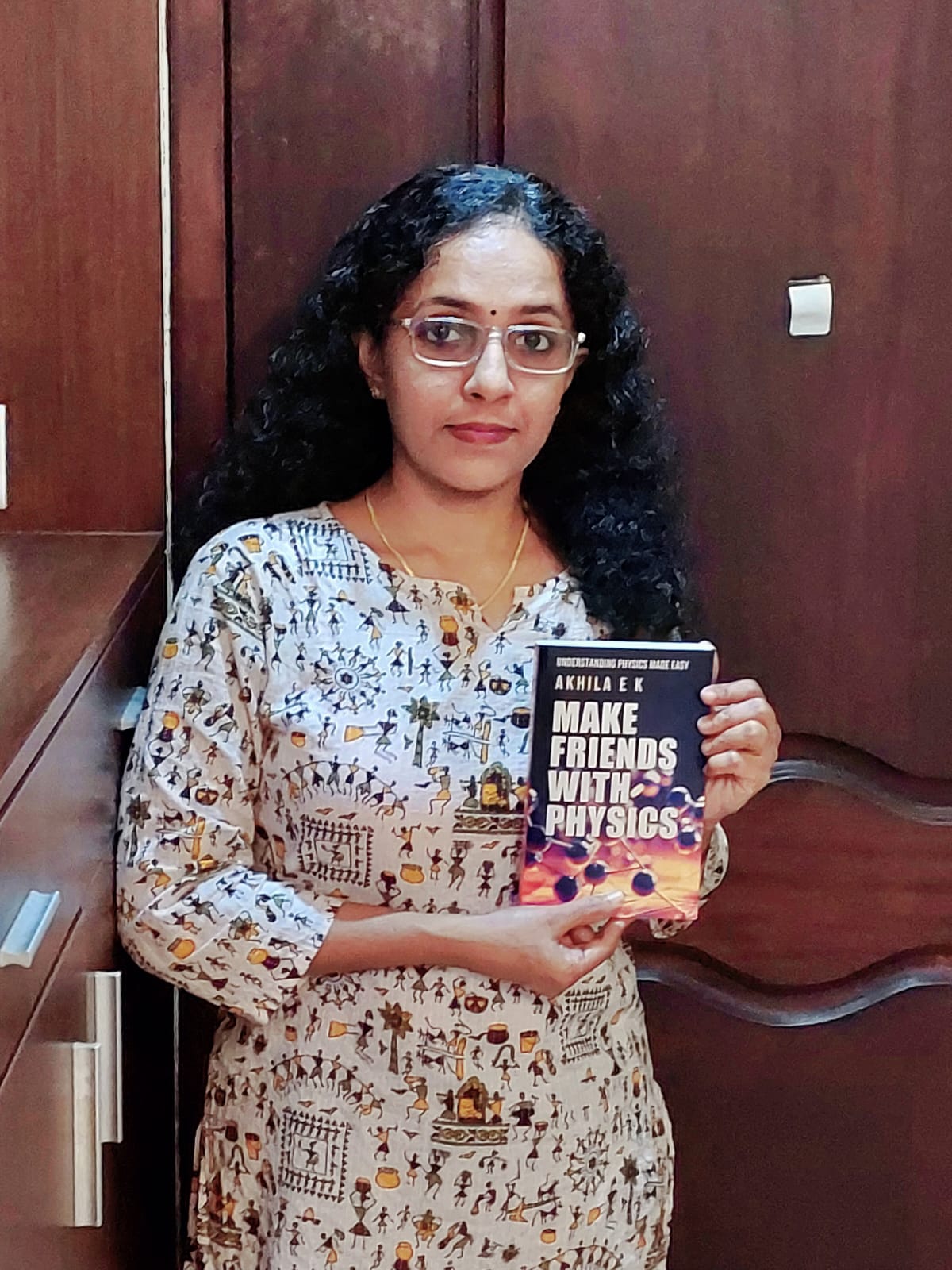 Akhila is a self-motivated lifelong learner, and a blogger bleeding out all the intoxicated imperfections of her soul through her words. As a science enthusiast, she delves into quantum mysteries and marvels at the cosmic relationships. Alternately, she tunes into signals from the Cosmos, embracing spirituality and trying to merge its deeper meanings with science. Occasionally, she channels her emotions into poetry, and she adeptly transitions into an analyst, crossing the realm of numbers and patterns.
Finding solace in nature, she nurtures her passion for plants and the wilderness.
She seamlessly blends poetry, physics, philosophy, patterns, and plants, forming a balanced and inquisitive approach to life that guides her journey with curiosity and wonder. As she explores these realms with profound depth and passion, her essence unfurls, deeply entwined with love and connections.
Akhila's works have graced several anthologies, online magazines and journals. She has authored two books—Know them, One answer to many questions (2017) and A Dew Chimes—Misty Poems (2022). She is currently working on two books: a Malayalam poetry collection as well an English poetry collection.
Akhila, a multidisciplinary individual, embraces various roles—former lecturer, former IT professional, quantitative data analyst, self-motivated lifelong learner, blogger, author, poetess, self-employed homemaker, seeker, and more.
Her interests span from 'A rose in the garden' to 'Out of Body Experiences,' from data analysis to quantum physics, and beyond. She resides in India with her family. She falls for books, rain, greens, waves, and people who are not afraid to be themselves.
Catch her notions online:
https://wordsandnotion.wordpress.com/
Twitter/X: @wordsandnotion

Comments