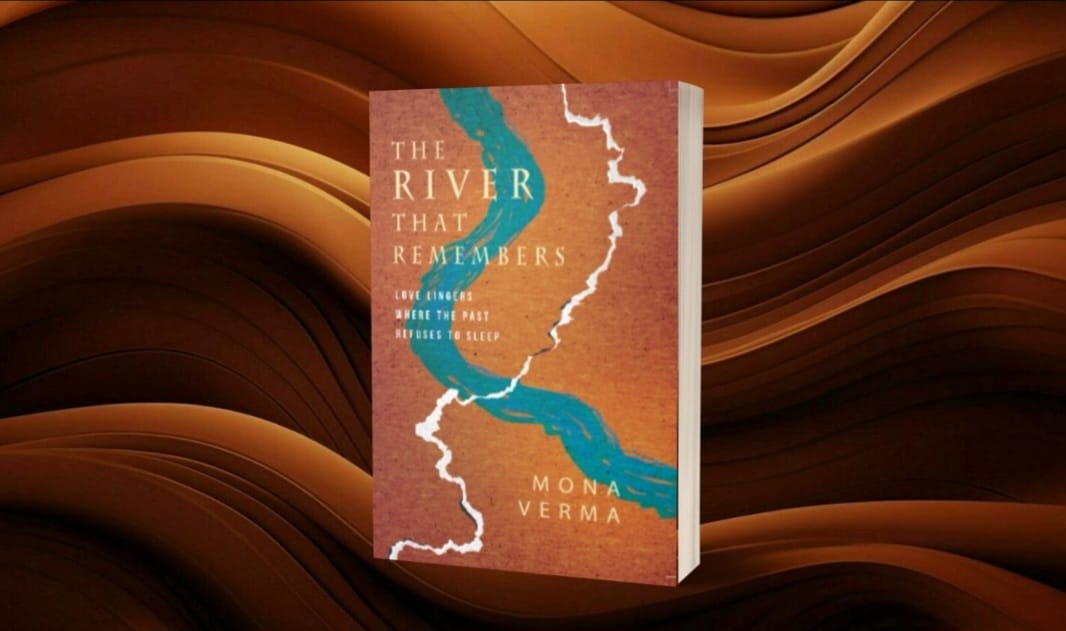
Why The River That Remembers Matters
As editors, we are trained to read with distance, to assess structure, language, pacing, and intent. And yet, every once in a while, a manuscript dismantles that distance entirely.
When I first read Mona Verma’s The River That Remembers, I was moved to tears. Not in a dramatic, immediate way, but in that slow, helpless manner when a story seeps in quietly and stays. Page after page, I found myself confronting the cruelty of circumstance—how history, in its sweeping indifference, marauds the most innocent of loves, leaving people to make choices they never imagined they would have to make.
What struck me deeply was the way the novel captures the fading line between morality and passion. In moments of fear and upheaval, what is right and what is necessary often collide. Mona does not judge her characters for the choices they make under impossible conditions; instead, she allows us to witness how love, loyalty, faith, and desire become entangled when survival itself is at stake. As an editor, I admire this restraint and honesty; it takes courage to let complexity breathe.
The novel is unflinching in its portrayal of loss. Tragedy follows tragedy, generation after generation, as though grief itself has been inherited. And yet, the book never slips into despair. What moved me just as much as the sorrow was the quiet insistence that life goes on. Children are born, homes are rebuilt, memories are buried, and routines resume—not because the past has been healed, but because people must continue living. This, perhaps, is one of the most truthful depictions of trauma I have encountered in fiction.
Mona’s handling of history is equally assured. She weaves in facts about India’s freedom struggle and the events surrounding Partition with care and precision, never allowing them to overwhelm the heart of the story. The historical context enriches the narrative without diluting its emotional core—a balance that is difficult to achieve and even harder to sustain across generations.
One of the book’s greatest strengths lies in its sense of place. Her descriptions of the streets and bazaars of Ghakkar Mandi are so vivid that they transport the reader entirely. You can hear the hum of daily life, smell spices and dust, taste the succulent baalushahi and the sizzling kababs, sense the press of crowds and the intimacy of narrow lanes. The setting is not merely described; it is felt. Reading these passages, I was acutely aware of how sensory memory anchors emotion, how places, like rivers, remember.
Why does Mona’s writing touch the reader’s heart?
Mona has seen the pain of Partition in her family. She narrates this story from experiences of her kith and kin. The massacre of Maharaj’s family in the book happened in reality. Her words are steeped with emotions that emanate from lived experiences.
This is what differentiates The River That Remembers from other books on the Partition. This book is raw and real, written by someone who has heard these stories every day from her family.
In Mona’s own words, “The River That Remembers is a book that waters my roots. Born into a family of displaced Punjabis from Gujranwala (now in Pakistan), I grew up with access to undocumented human narratives—stories that history books often overlook.
My grandparents never truly overcame the grief and pain of displacement. For them, it was a roadless journey into an uncertain future. Forced to leave their homes behind, they carried nothing with them to Hindustan except their memories and their stories.
These are the stories I tell in The River That Remembers—raw, moving, and deeply honest.”
The Cover
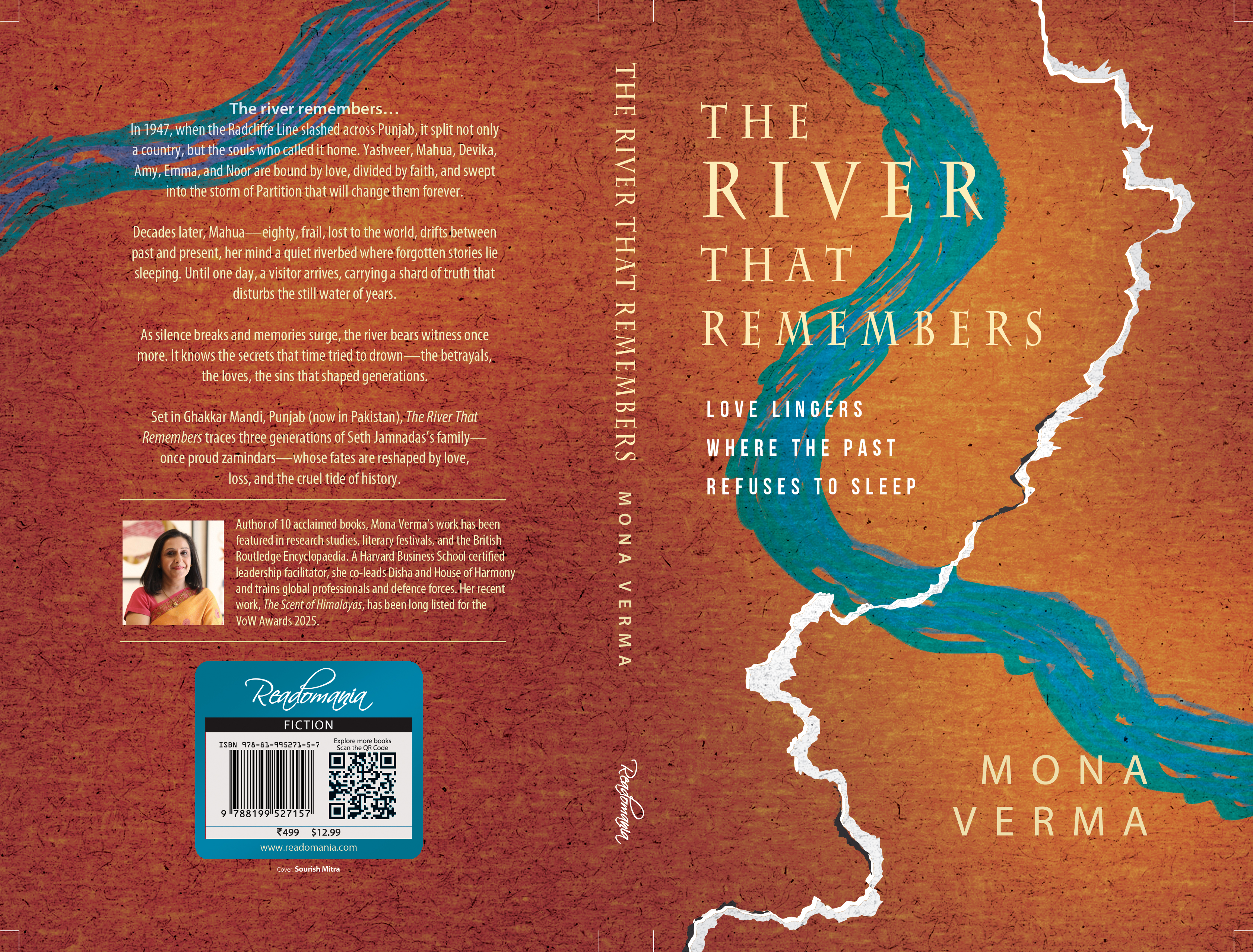
We envisioned the cover to portray the divide subtly. A gently winding river cutting across a faded map of Punjab, with the Radcliffe Line subtly visible, almost like a scar. There would be cracks, stains, or blood-red threads. No maps… just the outline of undivided Punjab on a slightly grainy, textured background, evoking aged paper.
Our lead designer Sourish Mitra executed this brief perfectly. Minimalist, subtle. A statement cover befitting a book that stays with you forever.
Why does this book feel so relevant today?
It reminds us that history does not end with dates or declarations of freedom. It lives on in families, in silences, in inherited fears and unfinished stories. In a time when narratives are increasingly polarised, The River That Remembers insists on nuance, empathy, and humanity.
The characters linger in your mind much after the book has ended. You root for them, you cry with them, their loss becomes your loss, you revel in their fleeting moments of happiness and hope, you feel the excruciating pain of the atrocities meted out by the brutal Britishers.
As an editor, I believe this is not just a novel about Partition—it is a novel about what we carry forward, knowingly or not. It asks us to sit with discomfort, to acknowledge loss without simplifying it, and to recognise that even in the wake of repeated tragedy, life—stubborn, fragile, and hopeful—continues.
Some manuscripts are well written. Some are important. And a rare few remind us why stories matter at all.
This is one of those rare books.
If you like the book, we are running a special offer on our website for this book. You get a discount of 20% on MRP.
Shop - The River That Remembers - Readomania
As an alternative, you can pick it from Amazon
Or ask your local bookstore for it.

Comments