Since 1924, exposition of the Indus Valley civilization has intrigued historians, archeologists and anyone with a fertile imagination. Especially because the Indus script has eluded decipher. And the fascination has not ended even today.

There is always some news about the ancient civilization that raises questions about it. Recent excavations have revealed that the settlement extended much beyond the 1.25 square kilometre triangle beginning from Balochistan to Uttar Pradesh and from Jammu to Maharashtra as believed earlier. Evidence from Keezhadi and Mayiladumpara in Tamil Nadu show links to it.
Excavations at Harappa, Mohenjo-daro, Dholavira, Rakhigarhi, Kalibangan and Lothal manifest it was a hygienic, bureaucratic, and peaceful civilization. Dug-out ruins and artifacts reveal its denizens’ excellent urban planning, engineering genius, economic system, industries and trade as well as a highly-evolved social and cultural organization.

The enigma of this 5,500-years-old civilization built across the Indus river and its tributaries has enthralled global historians, writers and of course, archeologists for years. As a scholar of both history and literature, it was impossible for me to escape the magnetism of Meluhha as it was called by Mesopotamian and Sumerian traders. However, I observed that stories relating to the civilization usually focused on the Mohenjodaran and Harappan archeological digs while other excavation sites were often neglected. When I began to study them, what jumped out at me was the potential provided by Lothal.
What is Lothal?
Around 80 kilometres by road from Ahmedabad in Gujarat is an Indus Valley excavation discovered by Shikaripura Ranganatha Rao in 1954. Situated near the Gulf of Khambat and on the old course of the Sabarmati river, it is an ancient port city and site of the world’s earliest known dockyard.

(Photo credit: Ms Chandra Sen)
Importance of Lothal
In Gujarati, Lothal means the mound of the dead, which is interesting. I am tempted to assume that local people, over centuries, had some intuition that a complete city existed under their feet. Maybe… maybe not…
According to the Archaeological Survey of India (ASI), the site is testament to the flourishing maritime trade conducted by the port. Seals and other artifacts point to a highly developed trading city including a warehouse, bead factory other than a dockyard.
What makes the dock special?
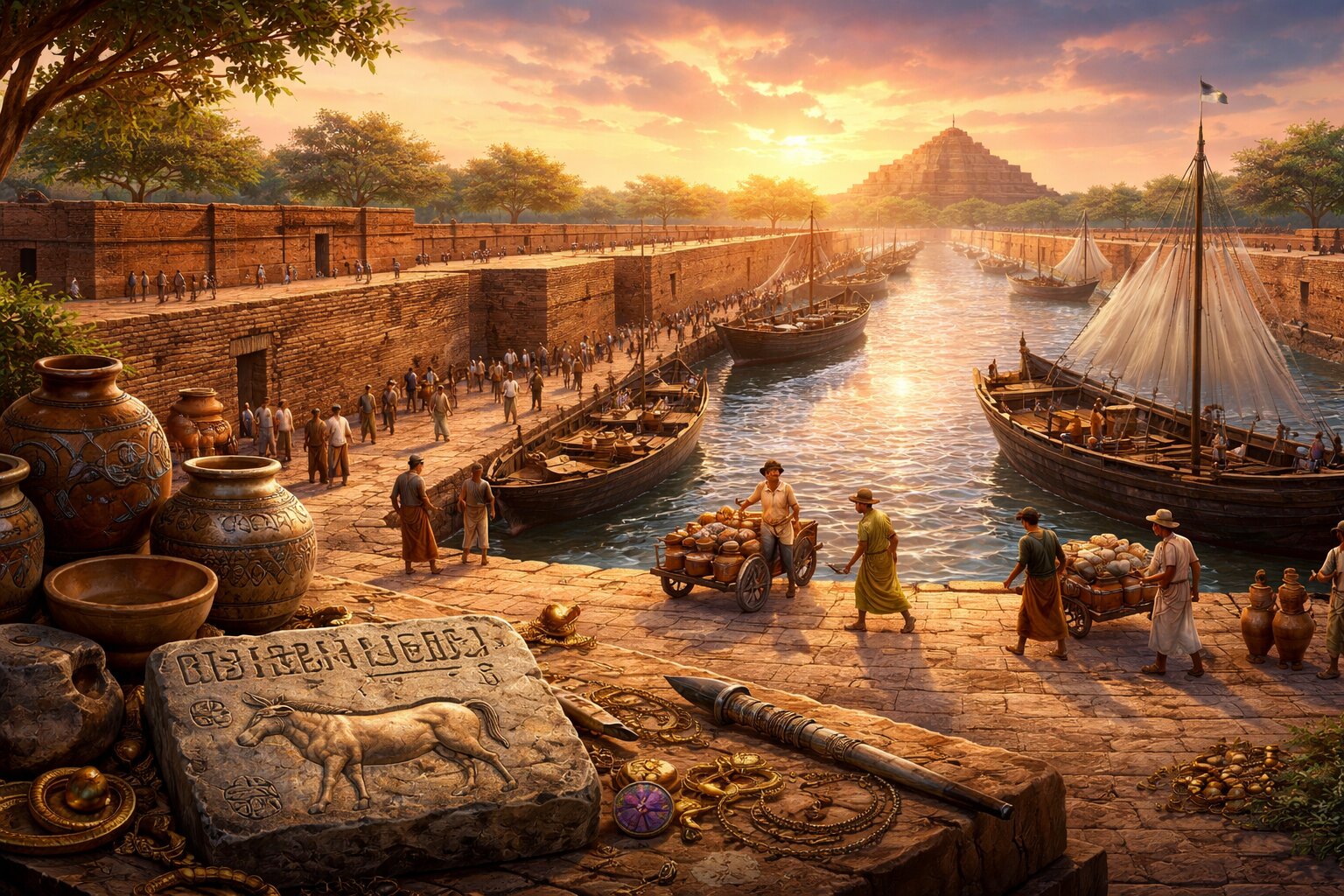
A trapezoidal, burnt brick structure, dockyard is located on the eastern side of the town. About 215 metres long and 35 metres wide, it was fed by an inlet connected to the Sabarmati river that joined the sea after flowing for a distance. During high tides, sea-faring ships sailed up the river and into the dockyard. Marine microfossils, salt, and gypsum crystals discovered in the dock walls prove it was fed by seawater. When the river changed its course in 2000 BCE, a canal was dug to the new river course. A mud brick wharf built on the western side of the dock has a ramp leading to the warehouse of the acropolis. To protect it from floods, the warehouse was built on a pedestal consisting of several blocks. The passages between the blocks served as vents that facilitated loading and unloading at the dock. Construction as well as strategy of this ancient dock is testimony to the unique Meluhhan architectural skills.

An artistic representation of Lothal
These techniques also extended to town planning. Lothal planners divided the town into platforms of sun-dried bricks, each for 20–30 houses of thick mud and brick walls. The city was divided into an acropolis and a lower town with paved bathing platforms, underground and surface drains and potable water well.
My investigation revealed Lothal’s multifarious industrial activities. Meluhhans were adept at metallurgy proved by the copper tools, musical instruments, vessels and metal moulds recovered from the site. They created jewellery of shells, gold, jasper, carnelian beads and made articles of faience and steatite. These articles have been dug out in Mesopotamian sites, evidence of trading ties between these civilizations. What never ceases to be a source of wonder are the measuring instruments and scales found in Lothal. Meluhhan scientific knowledge is verified from a compass, a sextant-type instrument and measuring scales that have been discovered. An ivory scale from Lothal even has the smallest-known decimal divisions in Indus civilization.

Ivory Scale
Why did I choose Lothal to set my story?
The fascinating facts about this ancient city compounded by how little most people know about it consolidated my decision that my thriller must be set in Lothal.
But that is not all.
All through my explorations, a question kept popping up. How and why did a town inhabited by such intelligent, skillful denizens decline?
A strange fact about Meluhha is that the civilization has no history of war unlike most other ancient civilizations. Besides no weapons have been discovered in any of its sites. All this indicates a peaceful and harmonious existence that make the civilization one of its kind. Archeologists have theorized that its decline was triggered by a massive drought caused by water sources such as the river moving far away.
However, myths and legends say something more fantastic. They suggest that the progressive-thinking Meluhhans possessed capabilities that dissuaded enemies from engaging with them aggressively.
These tales made my imagination soar.
What if Meluhhans had innovated a system to subjugate their enemies by constructing a powerful device?
They did not need to use it but simply spread a buzz about it. Rumours would serve to build so much apprehension and dread in enemies that they would abstain from attacks. And Lothal, the trading port that showcased the innate intelligence and skill of Meluhhans provided a perfect setting for my hypothesis.
Did such a device really exist?
That is the task that I have given to my archeologist-sleuth, Dr Jay Menon. In the course of proving this conjecture, what the other lethal secrets did she discover and had to secure even with bullets raining and dead bodies piling up?
That is the story you will discover between the pages of this history-mystery, Lethal Secret at Lothal.
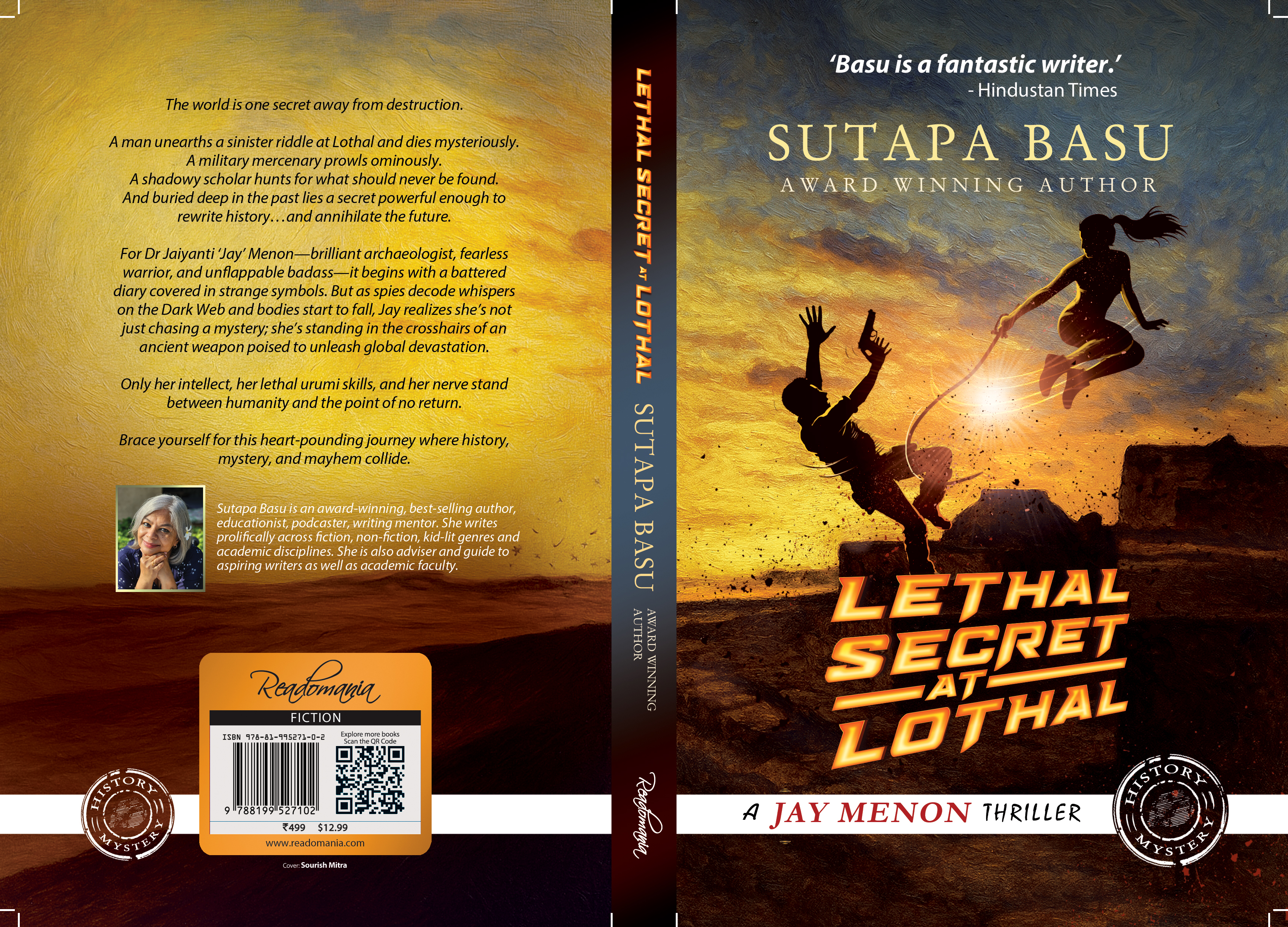
Grab your copy of Sutapa Basu's Lethal Secret at Lothal here

Comments