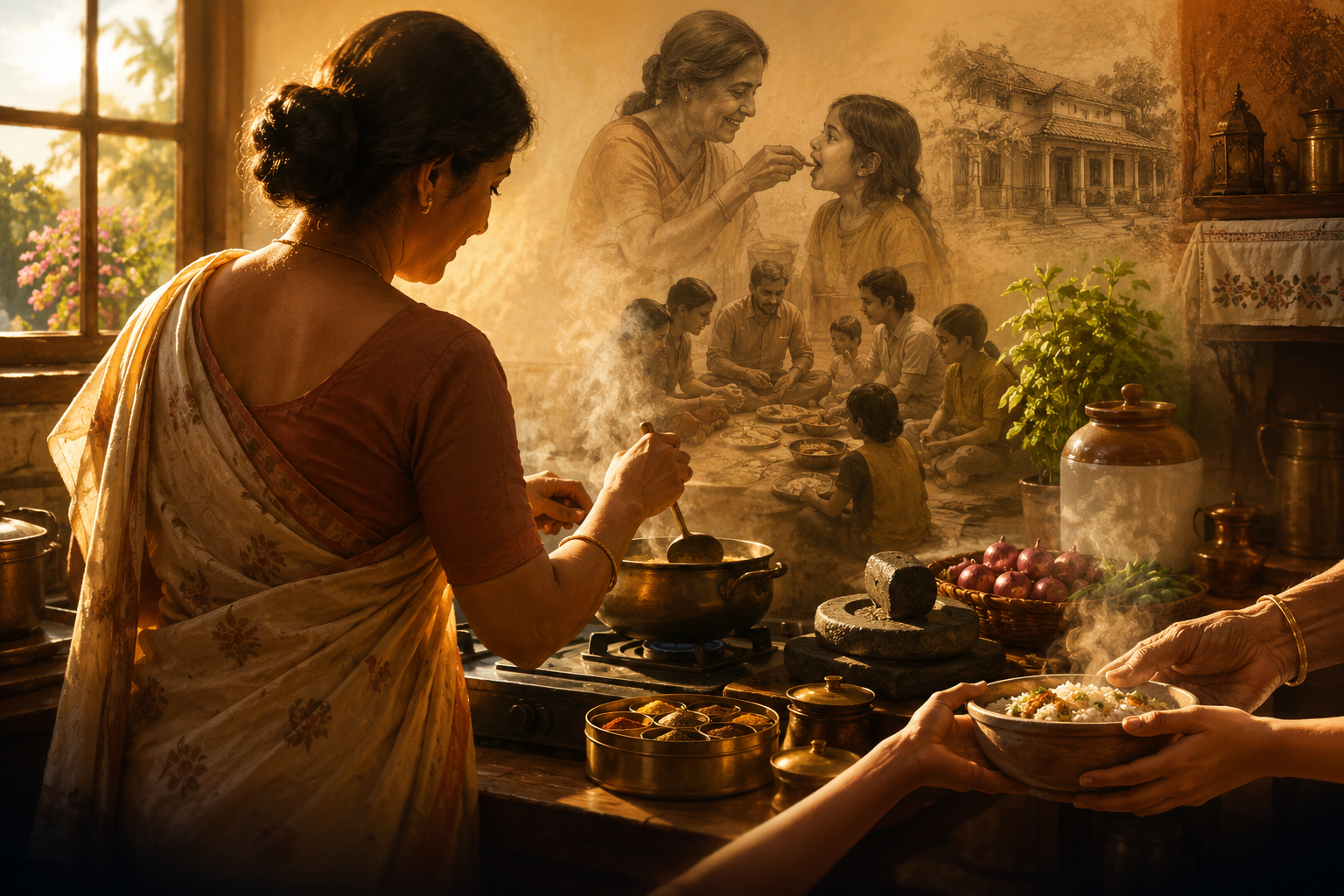
The Language of Love Is Cooked at Home
Food, Memory, and the Things We Never Outgrow
We travel to discover the world. We eat to discover its people.
From steaming bowls of ramen in Tokyo to flaky croissants in Paris, fragrant tagines in Morocco, tacos in Mexico, and handmade pasta in the hills of Tuscany, every journey leaves behind a trail of unforgettable flavours. Travel teaches us that food is perhaps the quickest way to understand a culture. It tells stories of geography, history, migration, climate, faith, and community. Every country speaks in its own culinary language.
And yet, after weeks or months away, when we finally return home, there is one meal we crave above all others.
Not the Michelin-starred dinner we proudly photographed. Not the famous local delicacy we queued hours to taste after seeing Instagram reels.
We long for dal and rice. Khichdi. Rasam. Aloo posto. Rajma chawal. Kadhi. Macher jhol. Rotis puffed straight off the flame. The mango pickle tucked away in an old ceramic jar. The cup of chai or filter kapi that somehow tastes different when made by familiar hands.
We long for our mother's cooking.
Because home food is rarely about food.
It is about memory.
Across India, every kitchen carries its own inheritance. Recipes are seldom written down. A grandmother adds ‘just enough’ turmeric. A mother knows exactly when the mustard seeds have crackled enough. A father makes the Sunday omelette the same way he has for forty years. Measurements live in the hand, not in spoons. Timing is judged by aroma rather than the clock.
Every family develops its own culinary dialect.
No restaurant can recreate that.
Scientists often say that smell is the sense most closely tied to memory. A single aroma can transport us decades into the past. The smell of tempering in hot ghee, the aroma of the Sunday mutton curry with big potatoes simmering, freshly ground coconut, frying fish or onions, roasting cumin, or rice just taken off the stove can collapse time. Suddenly we are children again, waiting impatiently for lunch while our mother tells us not to touch the hot chapatis or piping hot fish fry.
The kitchen becomes our first archive.
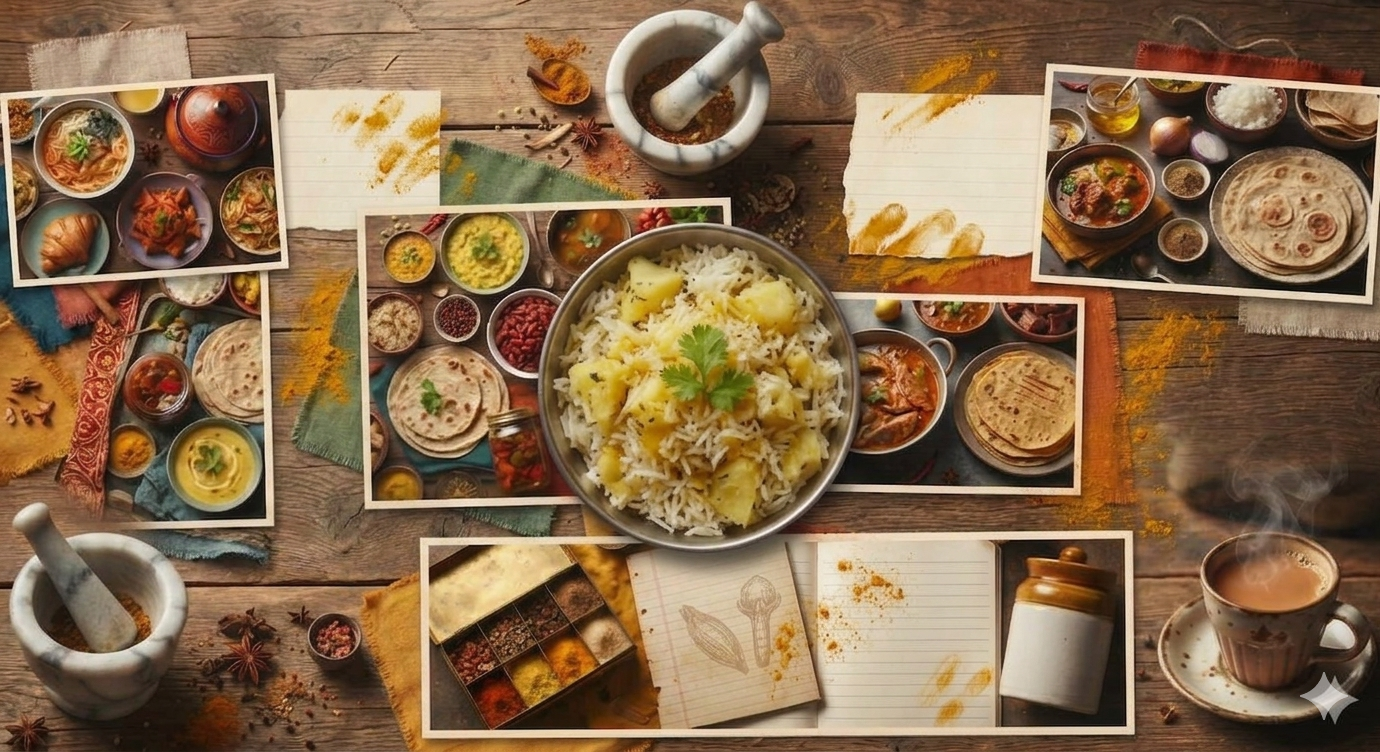
It records birthdays and festivals, illnesses and celebrations, exam mornings and monsoon evenings. It remembers who preferred extra chillies and who quietly removed the curry leaves from their plate. It remembers the special sweet prepared when someone came home after months away, or the comforting meal served after a difficult day.
Long before we understand history through books, we understand it through food.
In India especially, food is inseparable from identity. Every few hundred kilometres, the landscape changes… and so does the kitchen. The mustard oil of Bengal gives way to the sesame oil of Andhra. Coconut travels through Kerala and coastal Karnataka. Bajra and jowar sustain western India. Kashmir perfumes its food with fennel and saffron, while the Northeast celebrates bamboo shoots and smoked meats. Every state, every community, every family preserves its own traditions, passing them quietly from one generation to the next.
Migration adds another layer to these stories.
Families move for work, education, or marriage, carrying recipes with them like invisible heirlooms. Ingredients change. Markets are unfamiliar. Substitutions become necessary. New flavours enter old kitchens. Yet, people hold on to what they can because food becomes one of the strongest ways of holding on to home.
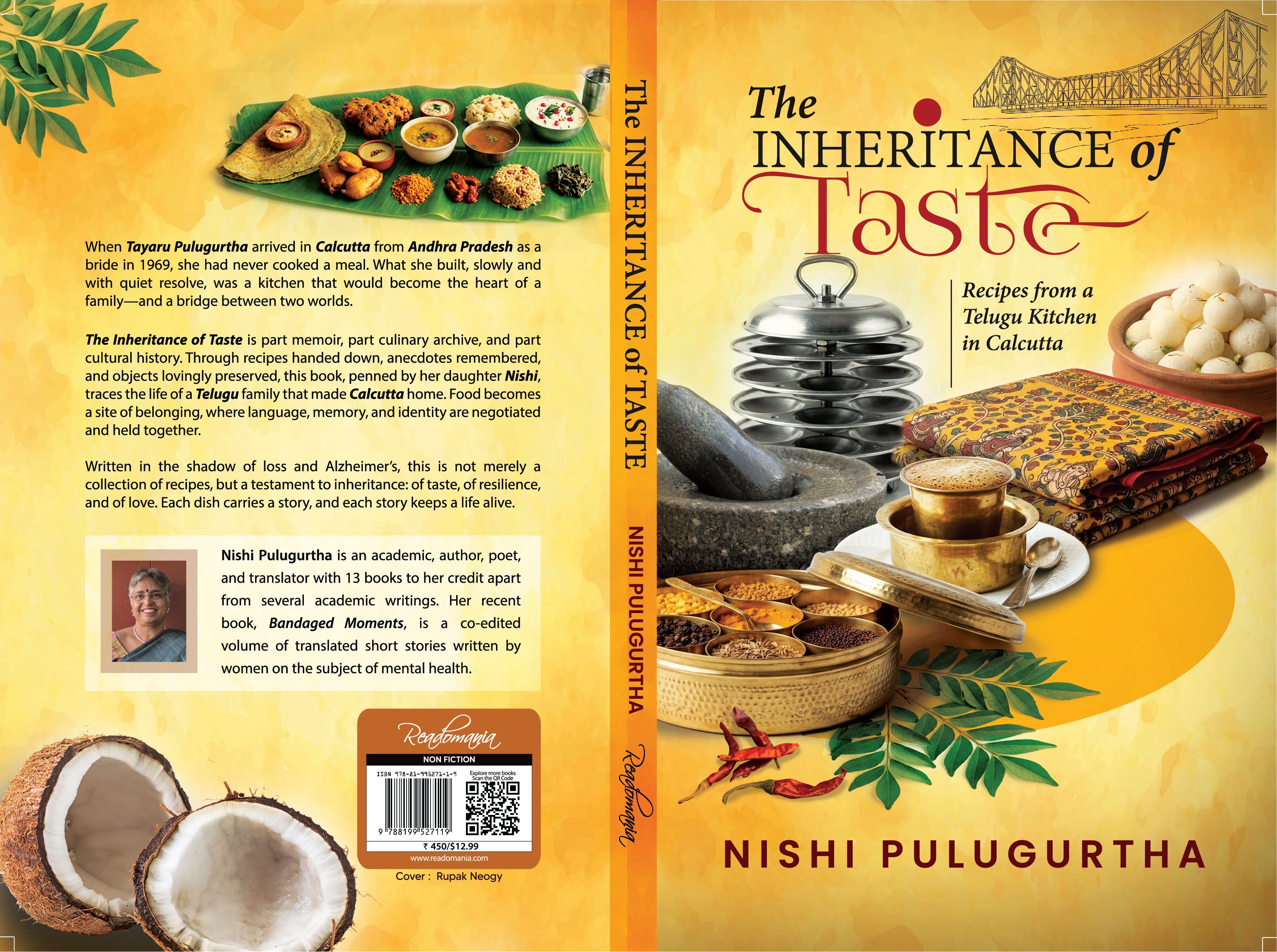
The Inheritance of Taste, a memoir built almost entirely around one woman's kitchen, captures this ache better than almost anything else out there. The author, Nishi Pulugurtha, writes of her mother, Tayaru, who married in 1969 and left Andhra Pradesh for Calcutta, a city whose language she didn't speak, to run a household she'd never had to run before. She had grown up in a home so full of relatives that she was never once asked to cook. Marriage handed her a stove, a city of strangers, and no instructions.
What follows is one of the most honest portraits of how home food is actually built—not inherited whole, but assembled piece by piece, often at great cost. There was no grinding stone in Calcutta, so there were no idlis or dosas for months, until her brother finally carried one over on a train, furious at the extra luggage fee. Curry leaves weren't available in the local market, so she went without them until she managed to grow her own plant—one that, decades later, still grows in her daughter's backyard. Coffee powder meant a long trip across the city. Recipes came by inland letter, in her own mother's handwriting, and later by way of cuttings clipped carefully from magazines and bound into volumes that outlived her.
Over the years, her Telugu cooking softened at the edges—a little less chilli, a little less sour—as Bengal quietly worked its way into the family's palate, the way a new city always does. But the essence, as her daughter writes, never left. It only adjusted. That's what home food really is, in the end: not a fixed recipe, but a living negotiation between where you're from and where you've landed, cooked fresh every single day by someone who loves you enough to keep figuring it out.
When Alzheimer's changed her mother, even her sense of taste changed with it—the woman who once loved things tangy and fierce began, quietly, to prefer sweetness. It's a small, devastating reminder that even the tongue we inherited from her was, in some sense, on loan.
That story is deeply Indian.
Thousands of women across the country have done exactly this.
A Punjabi bride learns to cook Assamese fish curry. A Bengali daughter-in-law begins making Gujarati theplas. A Tamil family in Delhi learns where to buy fresh curry leaves. A Maharashtrian living in Canada guards a carefully tended tulsi plant and stores homemade goda masala in airtight containers brought from Pune.
These kitchens become maps of migration.
The recipes survive because love insists that they should.
Perhaps that is why mothers rarely describe cooking as a performance. They cook because feeding the family is an act of care. They remember everyone's preferences without making a list. They know who likes softer rotis, who wants extra coriander, who secretly reaches for the crispiest potato, who prefers which fish piece. It is an invisible labour that often goes unnoticed until we leave home.
Only when we begin cooking for ourselves do we realise how much thought went into those seemingly ordinary meals.
And then comes the humbling discovery.
No matter how faithfully we follow the recipe, it still doesn't taste quite like hers.
Maybe because we missed an ingredient.
Or maybe because the missing ingredient was never something that could be measured.
As the years pass, many of us inherit not just recipes but responsibilities. We begin recreating family dishes for our own children. We write down recipes our mothers never thought needed writing down. We preserve pickle jars, brass utensils, spice boxes, handwritten notebooks stained with turmeric, and recipes scribbled on the backs of calendars.
We are preserving far more than food.
We are preserving voices.
The older we grow, the more we understand that our mothers were not merely cooking meals. They were quietly building memory, identity, belonging, and continuity—one meal at a time.
Perhaps that is why, after all our travels across continents, after tasting cuisines from every corner of the world, the meal that heals us remains astonishingly simple.
Hot rice.
A ladle of dal. Or that comforting alu and dim sheddo.
A spoonful of ghee.
Maybe a pickle from home.
Served not on fine porcelain, but on an ordinary steel plate.
Because comfort has never been about luxury.
It has always tasted like home.
And home, more often than not, tastes like mother.
Maa’s cooking is like a warm hug on a cold day. It can heal the tired soul, rejuvenate the overworked brain.
Find The Inheritance of Taste here.

Comments