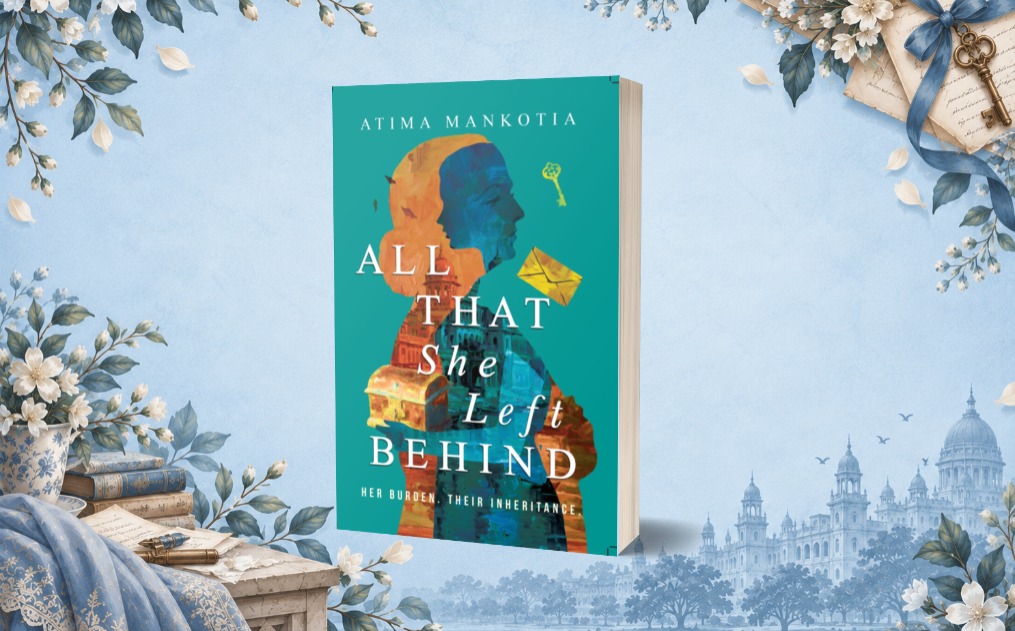
Is Inheritance About Property—or the Past We Carry?
Inheritance is usually discussed in the language of property: houses, land, jewellery, bank accounts and family businesses. We ask who gets what, whose name appears on the papers and whether the distribution is fair.
But what if inheritance extends beyond what can be owned?
What if we also inherit our parents’ silences, our grandparents’ fears, the wounds of marriages that came before us and secrets that families protect for decades? What if the most consequential inheritance is not the one we receive through a will, but the one we carry unknowingly in our relationships, choices and understanding of ourselves?
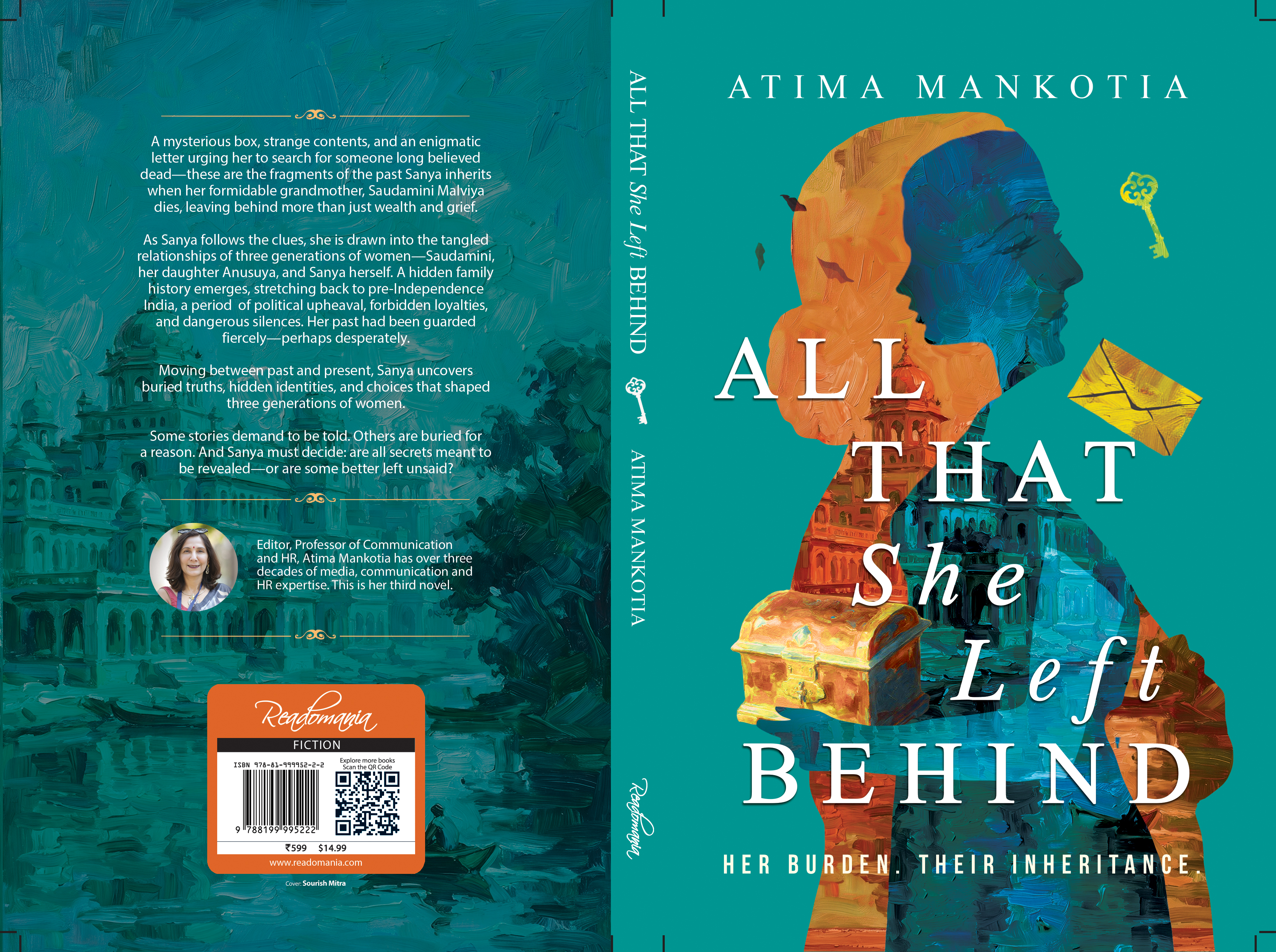
Atima Mankotia’s All That She Left Behind explores these questions through a family story in which inheritance becomes the starting point for uncovering a hidden past. Sanya’s grandmother’s death sets in motion revelations that challenge what she and her mother, Anusuya, believe they know about their family. What initially appears to be a matter of property and succession gradually opens into a deeper exploration of identity, abandonment, marital suffering, family loyalty and long-buried truths.
The novel reminds us that every family has an archive. Some of it is preserved in photographs, letters and legal documents. The rest survives in half-told stories, unexplained silences and memories that change depending on who is speaking.
The Inheritance of Silence
In many families, the past is not discussed; it is managed. Certain subjects are avoided, names are not mentioned, and difficult questions are dismissed with, “That was a long time ago.”
Yet silence does not make the past disappear. It often gives it a different form.
A child may grow up sensing tension between adults without understanding its origins. A daughter may mistake her mother’s defensiveness for coldness, or interpret her grandmother’s harshness without knowing the experiences that shaped her. Years later, when fragments of the truth emerge, old relationships can be viewed through an entirely different lens.
This emotional current runs through All That She Left Behind. Sanya shares a close bond with her grandmother, while the relationship between Saudamini and Anusuya is marked by conflict, resentment and unspoken understanding. The women love one another, but their relationships are complicated by old wounds and choices that have never been fully explained.
The novel reflects a familiar truth: love does not always make people kind, and shared history does not automatically create understanding. Sometimes, the people closest to us are the ones whose pain we understand the least. At other times, we discover that what we considered a personal failing was part of a much longer story.
The Things We Inherit Without Consent
Property can be accepted, rejected, sold or divided. Emotional inheritance is far less straightforward.
We may inherit a parent’s anxiety about money, a grandparent’s distrust of outsiders, a family’s discomfort with vulnerability or the belief that endurance is the same as strength. We absorb ideas about marriage, duty, sacrifice and respect long before we are old enough to question them.
These legacies are not always negative. Families also pass down resilience, humour, traditions, compassion, curiosity and the courage to begin again. A grandmother’s determination may inspire a granddaughter, while a parent’s hard-won wisdom may help a child avoid repeating a painful mistake.
The challenge lies in recognising what we have received.
Which beliefs are genuinely ours? Which fears were handed down to us? Which family patterns do we continue simply because they have existed for generations?
In Sanya’s story, the discovery of her family’s concealed history encourages her to reconsider the people around her—and herself. She is compelled to move beyond simplified ideas of her parents and grandmother. The past becomes something she must examine, not merely inherit.
When Property Becomes a Measure of Power
Inheritance is rarely only about money. It can also reveal the power dynamics within a family.
Who controls the property? Who is expected to receive it? Who believes they are entitled to it? And what happens when the person who owns the wealth refuses to distribute it according to family expectations?
In All That She Left Behind, Saudamini’s wealth is inseparable from her relationships. The apartment she gives her daughter is not simply an act of financial support; joint ownership also allows her to retain influence over Anusuya’s life and marriage. Meanwhile, Anusuya’s husband, Jairaj, reveals how property can become a source of entitlement, manipulation and conflict.
This dynamic extends beyond fiction. In families where wealth is concentrated in the hands of a few, inheritance can become a silent bargaining tool. Affection may be confused with obligation, while care may be offered with an expectation of future reward. Long-standing relationships can be tested when ownership enters the room.
A legal document may specify who receives a house, but it cannot determine who feels betrayed, overlooked or undervalued. It can distribute assets, but it cannot settle decades of resentment.
Inheritance disputes are therefore often about more than the objects or money being contested. They may represent an older struggle for recognition, approval or control.
The Women Who Leave More Than Wealth Behind
The novel’s focus on three generations of women invites us to consider the legacies women create, often without receiving formal recognition for them.
A woman’s inheritance may include property and financial security, but it may also consist of the education she fought to receive, the home she built, the choices she was denied or the freedoms she secured for the next generation. Sometimes, the most meaningful inheritance is the permission to live differently.
Yet women’s histories are frequently reduced to their roles within the family. Their ambitions, compromises, anger and desires can disappear behind the labels of wife, mother or grandmother. Their private lives may remain unknown even to those closest to them.
Saudamini, Anusuya and Sanya are connected not only by blood but also by the consequences of decisions made before one generation was born. Their story encourages us to reflect on how women’s lives are remembered—and how much of their truth is lost when families protect reputation more carefully than memory.
What might we understand differently if we knew the complete stories of the women who raised us? What sacrifices went unacknowledged? What dreams were abandoned? What choices were made out of fear, love, social pressure or survival?
The answers may not always be comfortable. Understanding does not require us to approve of every decision. It asks us to see people as more complex than the roles they occupied in our lives.
Can We Choose What We Pass On?
We cannot choose the family we are born into, nor can we rewrite everything that happened before us. But we can decide how we respond to what we inherit.
We can question the idea that family loyalty demands silence. We can recognise that protecting a family’s image should not come at the cost of an individual’s dignity. We can learn to distinguish forgiveness from forgetting, and empathy from excusing harmful behaviour.
Most importantly, we can choose not to pass every unresolved wound to the next generation.
This does not mean that the past can always be neatly resolved. Some questions may remain unanswered, and some relationships may never become what we wish they had been. Certain truths, once discovered, may complicate rather than repair our understanding.
But knowledge can create the possibility of choice.
A daughter who understands the history behind her mother’s decisions may respond with greater empathy. A family that speaks honestly about its past may prevent its silences from becoming another generation’s burden. An individual who recognises inherited patterns may decide to break them.
Perhaps that is one of the most meaningful forms of inheritance: the ability to transform what we have received.
What Will We Leave Behind?
The title All That She Left Behind evokes more than the possessions of a woman who has died. It raises a larger question about the traces every person leaves in the lives of others.
Will we be remembered for the wealth we accumulated, or for the ways in which we made people feel? For the property we transferred, or the confidence we nurtured? For the secrets we protected, or the truths we had the courage to confront?
Perhaps inheritance is both material and emotional. It is the house and the history, the jewellery and the memory, the legal document and the unfinished conversation. It is what we leave behind—and what others continue to carry long after we are gone.
In the end, the most important question may not be ‘What have we inherited?’, but ‘What will we do with the past entrusted to us?’
Will we allow it to dictate our future? Will we remain trapped by the silences and resentments of those who came before us? Or will we examine them honestly, retain what gives us strength and leave behind what causes harm?
Because every generation receives an inheritance.
And every generation has the opportunity to decide what deserves to continue.
Get Atima Mankotia's All That She Left Behind here

Comments