The History Your Textbook Left Out
Why Children Need to Discover the Untold Stories of India
In 1931, two schoolgirls in Comilla, Bengal, took part in a revolutionary action against British rule. Santi Ghosh was 15. Suniti Choudhury was 14.
Most children today have never heard their names.
That’s not because the girls were unimportant. School history has a brutally hard job: fit centuries into a syllabus, an exam and a limited number of classroom hours. Some events and personalities get the attention. Everyone else waits outside the door.
The waiting list is long and fascinating. It includes tribal leaders, teenage revolutionaries, mathematicians whose ideas rewired the world, and pieces of geography that quietly shaped a nation. These stories don’t contradict the textbook. They complete it.
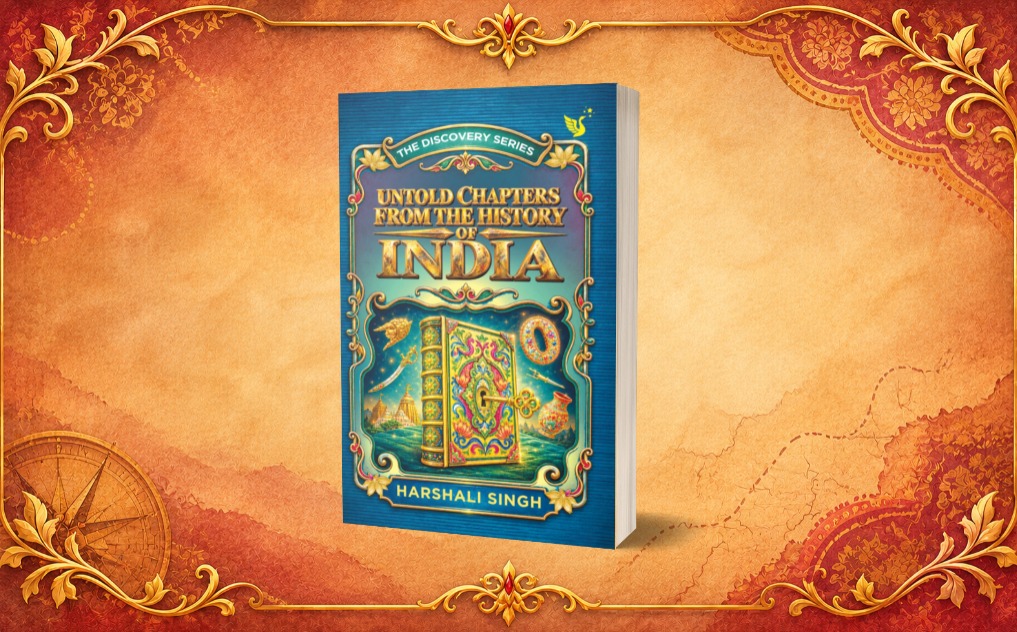
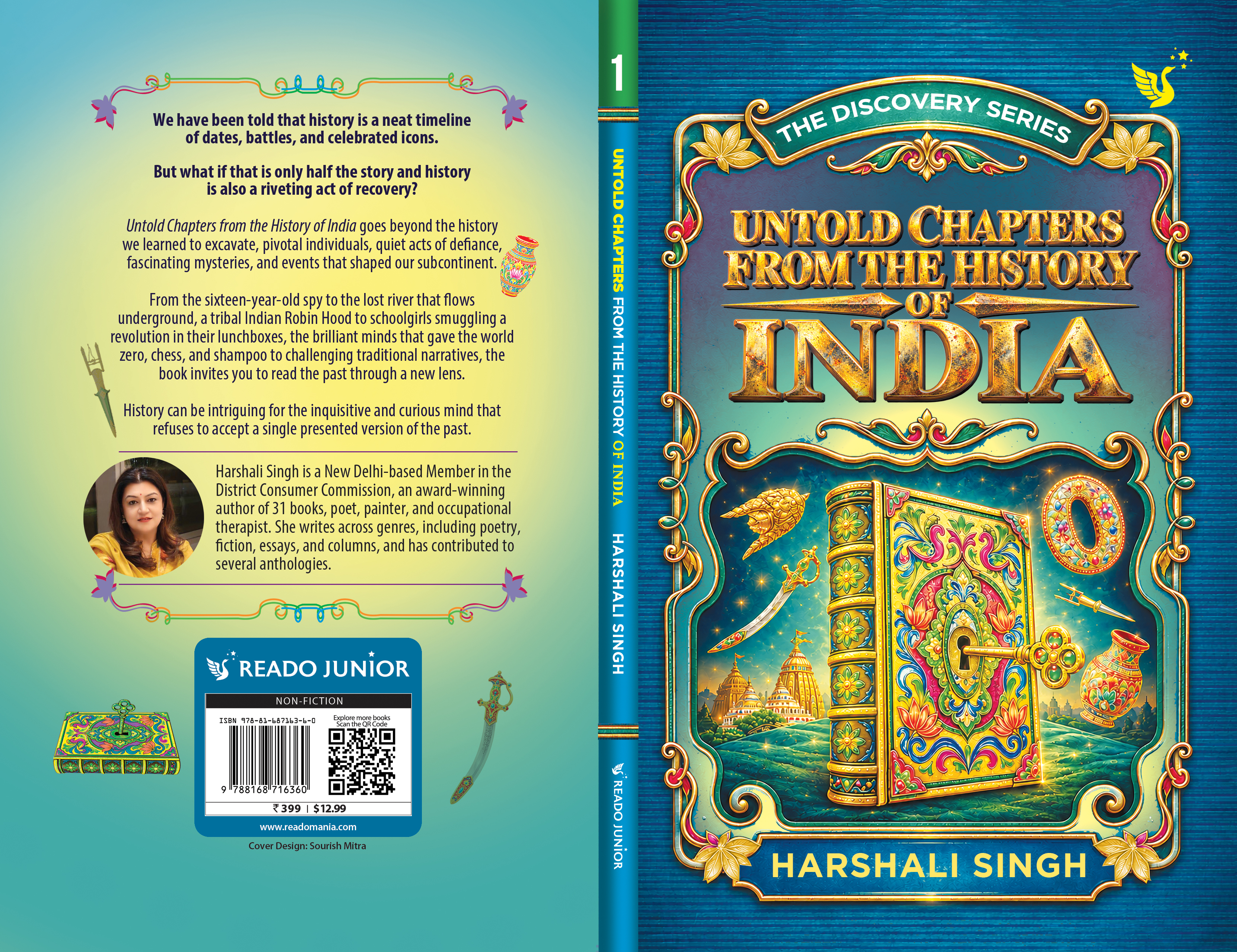
From forgotten freedom fighters and unsung heroes to lost rivers, strategic corridors, ancient universities, scientific mysteries, architectural marvels and the origins of everyday inventions, Untold Chapters from the History of India: Book 1 by Harshali Singh takes readers on a fascinating journey across 25 stories that reveal the extraordinary layers of India's past. It explores everything from mythology, archaeology and mathematics to trade, geography and sport, connecting seemingly unrelated discoveries to the world we live in today. Harshali reminds us that history is not merely about remembering what happened, but about discovering what we never knew. Because the more we uncover about India's past, the better we understand its present.
When history is your own age
Children usually meet historical figures as distant adults, frozen in portraits. Then they meet Santi and Suniti: two girls, barely older than a middle-schooler today, caught up in one of the most consequential episodes of their time.
Suddenly the past isn’t far away. It’s sitting at the next desk.
Stories like this open up conversations about courage, conviction and the different ways people respond to injustice. They deserve context and sensitivity, not a one-line tale of heroism. But they teach something no timeline can: age doesn’t decide whether a person can influence the world around them.
The outlaw who was a protector
To the British, Tantia Bhil was a dangerous outlaw. To the Adivasi communities of the Satpura region, he was Tantia Mama, their protector.
Same man. Two completely different stories.
In the 19th century, he waged a prolonged guerrilla struggle against British forces, drawing on his knowledge of the forests and hills. His story widens the freedom movement far beyond the leaders children already know. It also hands them a question that will outlast any exam: whose version of history am I reading, and whose has been left out?
The number that built the modern world
Zero seems too ordinary to have a story. Children use it without a second thought. But behind it lies an extraordinary intellectual journey.
Indian mathematicians, Brahmagupta among them, helped establish zero as a number with defined mathematical properties. The ideas that grew around the Indian numeral system travelled across regions and became part of the foundations of modern mathematics.
Follow that thread forward and it runs through computing, electronic banking, GPS and medical imaging. An idea worked out centuries ago is still at work in the world children live in today.
A flag that seems to defy the wind
At the Jagannath Temple in Puri, devotees see a flag that appears to flutter against the wind. For believers, it is a remarkable spiritual phenomenon.
Now add the temple’s architecture and the possible airflow patterns around it. Suddenly a child is holding faith, observation, engineering and natural science in the same hand.
The point isn’t to explain away a tradition or insist on a single answer. It’s to encourage curiosity: to help children ask questions, weigh evidence and appreciate the many layers behind a single phenomenon.
The thin strip that holds a region together
On a map, the Siliguri Corridor looks like a narrow sliver. In reality, it is the principal land connection between Northeast India and the rest of the country, and its story begins with Partition.
Once a child learns that, maps stop being collections of lines. They become evidence. A border, a river or a strip of land turns into the result of decisions made decades ago, still shaping life today.
That is what makes this kind of reading powerful. It shows children that history and geography are not separate subjects. They are constantly influencing each other, and together they explain why certain places matter now.
Curiosity is the real lesson
A textbook can introduce a subject. A well-told story makes a child want to chase it.
One chapter sends a reader looking for more about a freedom fighter’s life. Another sparks an interest in ancient mathematics. A temple inspires questions about architecture. A strategic corridor sends a young reader hunting for maps.
That is how curiosity grows: through questions that lead to more questions.
The best history books for young readers do two things at once. The narrative pulls children into the event, while the context helps them tell the difference between a dramatised telling and the historical record. Maps, timelines, illustrations and suggestions for further reading make the experience richer still.
A more inclusive India
India’s past is too vast to be understood through a handful of familiar names. It spans regions, communities, languages and traditions, and it has been shaped by many voices.
Children who read widely learn to ask better questions. Who recorded this event? What evidence supports the claim? Whose perspective is here, and whose is missing? These habits matter far beyond the history classroom. They make informed, discerning readers.
Parents and educators can help. Alongside prescribed textbooks, they can encourage age-appropriate historical nonfiction, biographies, illustrated histories and regional stories. Libraries and schools can make such books easy to find. And a conversation at the dinner table can turn one newly discovered story into a family adventure.
Where to begin
Untold Chapters from the History of India: Book 1 by Harshali Singh does exactly this. Across its 25 chapters, Harshali demonstrates that history is far more than a record of rulers, wars and dates. It lives in forgotten acts of courage, ingenious discoveries, architectural marvels, ancient traditions and everyday objects whose origins we rarely stop to question.
For children, these stories offer something more valuable than facts to memorise: the confidence to question, the curiosity to investigate and the ability to look at the world with a deeper understanding of how the past shapes the present. Because history should not end with what is printed in a school textbook.
It doesn’t replace the school curriculum. It enriches it.
Because the best way to make children love history isn’t to ask them to remember it. It’s to give them stories that make them want to discover more.
Get your copy here

Comments